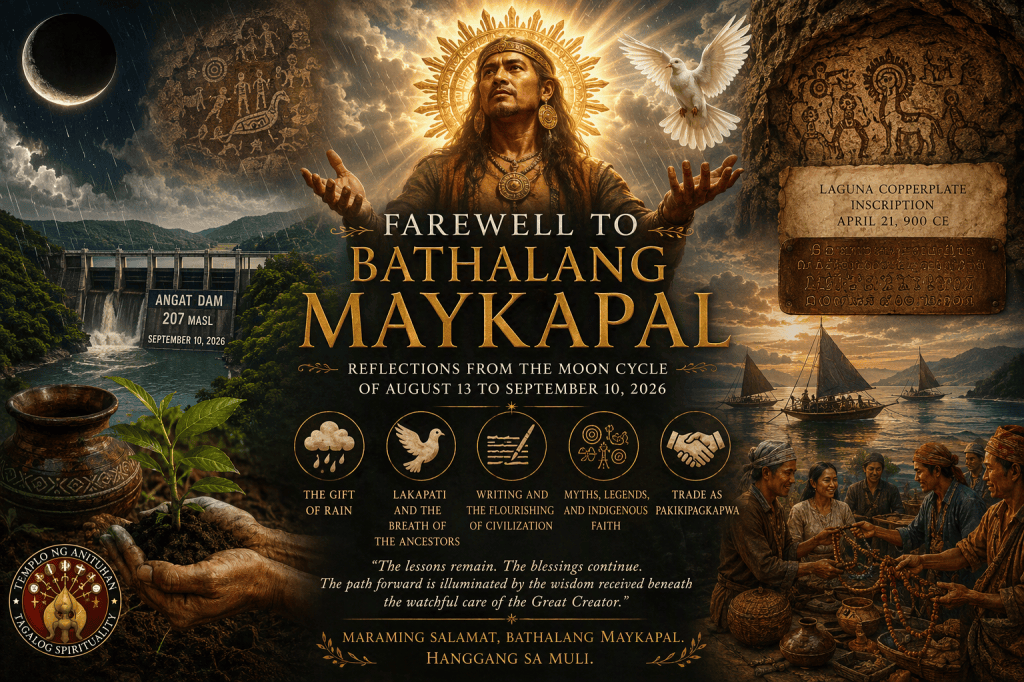
As the New Moon rises over the Philippines on September 10, 2026, we come to the completion of another sacred moon cycle within the traditions of Templong Anituhan. While I am presently in Hawai’i conducting the first day of the Hilot Binabaylan Informed Competency Certification, the cycle of the heavens continues its movement, reminding us that every season of guidance must eventually give way to another.
This moon cycle began on August 13, 2026, under the guardianship and guidance of Bathalang Maykapal, the Great Creator and Supreme Deity of the Tagalog people. As we prepare to respectfully bid farewell to Bathala as our Temple Guide and Guard for this cycle, it is fitting to remember the lessons, blessings, and insights He imparted to us.
Bathala and the Gift of Rain
One of the most profound experiences during this cycle was our collective prayer for rain.
The effects of drought had become increasingly felt throughout many parts of the Philippines. As I have done in previous years through the guidance of Diwatang Makaako of the Kinaray-a people, I once again offered prayers and petitions. This time, however, I turned to Bathalang Maykapal and asked that relief be sent to our communities suffering from water scarcity.
Particularly close to my heart was the condition of Angat Dam, whose water levels directly affect the people of San Jose del Monte City, Bulacan and millions of residents throughout Metro Manila and nearby provinces.
Through prayer and ritual observance, we called upon Bathala for mercy and balance. By the end of this moon cycle, the waters of Angat Dam had risen significantly, reaching approximately 207 meters above sea level. For many who had endured weeks of uncertainty caused by water shortages, this development became a powerful reminder that water is not merely a resource but a sacred blessing connecting heaven, earth, and humanity.
In this blessing of rain, Bathala reminded us that true prosperity cannot exist where the waters cease to flow.
Lakapati and the Breath of the Ancestors
Through Bathalang Maykapal, another teaching emerged through the presence of Diwatang Lakapati, the ancient bringer of fertility, abundance, and agricultural renewal.
Lakapati reminded us that healing begins beneath our feet.
The land is not simply property to be owned, sold, or exploited. The soil itself carries memory. It preserves the footprints, labor, sacrifices, and dreams of those who came before us. Every field, mountain, riverbank, and forest bears witness to the breath of our ancestors.
During this moon cycle, Lakapati taught us to give life back to the earth.
To cultivate the soil is not merely an agricultural act. It is an act of reconnection. By caring for the land, we honor the generations who nurtured it before us and ensure that future generations may continue to draw life from it.
The earth remembers us because our ancestors remain present within it.
Bathala, Writing, and the Flourishing of Civilization
Another important lesson revealed during this cycle concerned the role of writing, knowledge, and trade in the development of our ancestors.
Bathala showed that civilization flourishes when people are able to communicate, exchange ideas, and preserve wisdom across generations.
The earliest surviving written document from the Philippines, the Laguna Copperplate Inscription, dated April 21, 900 CE, demonstrates that our ancestors possessed sophisticated systems of writing, law, governance, and trade long before colonial contact.
Yet Bathala’s teachings directed our attention even further into antiquity.
Long before the arrival of Indianized influences that introduced terms such as Bathala and Diwata into the cultural vocabulary of the archipelago, our ancestors were already expressing themselves through symbols and markings. The ancient petroglyphs of Angono and Binangonan stand as enduring testimony that the peoples of Katagalugan possessed creative, symbolic, and spiritual traditions reaching back thousands of years.
These ancient carvings remind us that the spirit of creation and communication was already alive among our ancestors. Although the names by which we understand divinity may have evolved through contact, trade, and cultural exchange, the sacred relationship between the people and the Creator predates those names.
For me, the Angono Petroglyphs strengthen the understanding that Maykapal’s presence and jurisdiction over the lands of Katagalugan existed long before any recorded history.
Myths, Legends, and Indigenous Faith
One of the most meaningful teachings from Bathalang Maykapal during this cycle concerns the value of myths and legends.
Too often, myths are dismissed as mere stories. Yet our ancestral narratives contain memories preserved through generations.
They reveal how our forebears understood creation, community, morality, nature, and the sacred.
Bathala reminded us that myths and legends are evidence that the Filipino people possessed their own systems of faith, worldview, and spirituality long before external religious traditions arrived on our shores.
Our stories are more than entertainment.
They are vessels of identity.
Within them are encoded ancestral wisdom, cultural memory, ethical teachings, and spiritual truths that continue to guide us today.
Trade as an Expression of Pakikipagkapwa
The final lesson of this moon cycle emerged through reflection upon ancient Southeast Asian trade networks.
Trade was never solely about goods.
It was about relationships.
Through trade, communities encountered one another, exchanged ideas, forged alliances, shared technologies, and developed mutual respect. It was through these interactions that cultural concepts traveled throughout the region and found new expressions within local traditions.
Bathala revealed that ancient commerce was also an expression of pakikipagkapwa.
It reflected the recognition that one’s well-being is interconnected with the well-being of others.
The prosperity of one community contributed to the prosperity of another. In this way, trade became a sacred practice of reciprocity, cooperation, and human connection.
A Farewell for Now
As this moon cycle comes to its conclusion, we offer our gratitude to Bathalang Maykapal for His guidance, protection, and teachings.
Through rain, we learned the sacredness of water.
Through Lakapati, we learned the sacredness of the earth.
Through writing and trade, we learned the sacredness of human creativity and community.
Through myths and legends, we learned the sacredness of ancestral memory.
And through all these teachings, Bathala reminded us that our identity as a people is rooted in our relationship with the land, our ancestors, one another, and the Divine.
As we bid farewell to Bathalang Maykapal as the Temple Guide and Guard of this moon cycle, we do so not in sorrow but in gratitude.
The lessons remain.
The blessings continue.
And the path forward is illuminated by the wisdom received beneath the watchful care of the Great Creator.
Maraming salamat, Bathalang Maykapal. Hanggang sa muli.


Leave a Reply