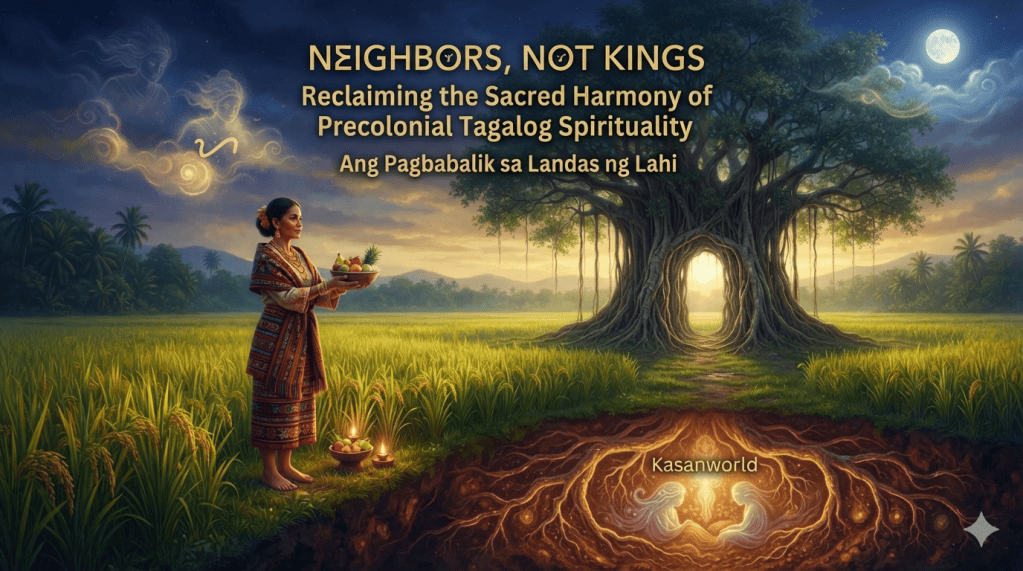
For centuries, the story of our ancestors’ beliefs has been told through a borrowed lens. When Spanish chroniclers arrived on our shores in the 16th century, they brought with them a worldview built on cosmic warfare—an absolute battle between a distant, heavenly God and a malicious, fallen Devil. Looking at the beautiful, fluid spiritual landscape of the ancient Tagalogs, the colonizers did what they knew best: they mapped their own anxieties onto our land. They turned Bathala into a solitary patriarch, the diwata into minor angels or saints, and a collective linguistic concept of underworld decay—sitan—into a singular, rival King of Hell named Sitan.
But our ancestors never believed in a cosmic war. They did not divide the universe into a rigid battlefield of good versus evil. To peel back the colonial layers of Tagalog cosmology is to uncover a profound, egalitarian truth: we did not live under spiritual tyrants. In the Middleworld, we lived among neighbors.
The Tripartite Cosmos of Balance
To understand precolonial Tagalog spirituality, we must look at the universe not as a ladder of moral hierarchy, but as an interconnected ecosystem divided into three fluid realms: Kaluwalhatian (the Upperworld), Kapatagan (the Middleworld), and the Underworld.
Kaluwalhatian was the radiant skyworld, the seat of Bathala Maykapal and the major celestial deities like Mayari and Apolaki. Yet, the gods of the sky were never out of reach. The “functional diwata”—such as Lakapati, the intersex deity of fertility and agriculture, and Mapulon, the changer of seasons [1]—were active commuters. They did not demand blind submission from a distant throne; they physically descended into the mud of the earth, walked the fields with humans, and breathed skill into the hands of weavers and blacksmiths.
Below this lay the Underworld, containing Maca, the village of peaceful rest for virtuous souls, and Kasanaan, the subterranean realm of grief. Far from being a torture chamber designed by an angry deity to punish religious sins, the Underworld was simply the natural destination for those who died out of harmony with their community.
Between the heights of the sky and the depths of the soil lay Kapatagan—the Earthworld. This is the plane where humanity resided, but we were never its masters.
The Law of the Neighborhood
In Afro-Brazilian traditions like Quimbanda, the physical world is explicitly mapped into seven distinct spiritual kingdoms, each ruled by bureaucratic kings and queens. The Tagalog Kapatagan possessed no such borders. It was one continuous, shared neighborhood.
Humans shared this physical plane with the Nuno sa Punso (mound dwellers), the Lamang-lupa (earth beings), the Lambana (forest fairies), and the Anitos (the spirits of our own immediate ancestors). These entities were not rulers to bow down to; they were our elder neighbors.
This neighborly coexistence dictated every action of precolonial daily life. If a Tagalog needed to cut timber, clear a field, or hunt in the wild, they performed a pag-alay—a small offering of food or gold. It was not an act of groveling fear, but the spiritual equivalent of knocking on a neighbor’s door to ask if you could borrow a tool or harvest from their overhanging tree. When walking through the forest or past a termite mound, they whispered, “Tabi-tabi po”—”Please step aside, neighbor”—a simple gesture of spatial courtesy so as not to step on or disturb those who lived there first.
In this worldview, morality was entirely situational and community-focused. “Good” and “evil” were not cosmic laws written in stone; they were human interpretations of harmony and disruption. If a human acted with greed, violated a sacred grove, or broke village solidarity, they disrupted the balance of the neighborhood. The resulting sickness or crop failure was not a divine curse, but the mechanical reaction of an ecosystem trying to rebalance itself.
Sitan: The Loyal Servant of the Depths
Perhaps the greatest colonial distortion lies in the figure of Sitan. Originally a term introduced through precolonial trade with Muslim-Malay merchants—derived from the Arabic Shaytan [1]—the Spanish weaponized his name to create a cosmic scapegoat, an adversary responsible for human suffering so that the supreme deity remained blameless.
But strip away the Abrahamic lens, and a breathtaking natural philosophy emerges. Sitan was never Bathala’s enemy; he was his most loyal servant.
Think of the underworld force like a cobra. A cobra is a magnificent, divine creature of nature. It possesses deadly venom, yet it does not strike out of malice; it bites only when its habitat is disrupted, or when a human carelessly steps on it. Sitan and the spirits beneath the earth represented this exact force: the heavy, necessary darkness of decomposition, nighttime, and death.
Like a piece of fruit that grows ripe at the highest branch of a tree, becomes heavy, and falls to the earth, this underworld force dropped to the very center of creation. There, at the core, it became the foundation of gravity—the very weight that holds Kapatagan together, keeping mankind, rivers, and mountains firmly anchored to the ground.
Sitan is the Lord of Germination. Life cannot begin in the open sky; a seed must first be buried in the dark, pressurized womb of the earth, where its outer shell decays and cracks open. By pulling moisture downward and pushing nutrients upward, the underworld force works in perfect, silent partnership with Bathala. It builds the mounds that grow into mountain ranges like the Sierra Madre, creating natural shields that absorb the fury of typhoons to protect the plains below. Bathala rules the heights, and Sitan anchors the depths. They are two hands of the same grand ecosystem.
The Diplomat of the Cosmos: How the Katalonan Negotiated Boundaries
In a world where humans shared the physical plane with a dense network of spiritual neighbors, you could not simply wage war against a localized illness or guess how much timber you were allowed to cut. You needed a diplomat. You needed someone who understood the intricate languages, micro-etiquettes, and boundaries of all three realms.
This was the sacred mandate of the Katalonan (the precolonial Tagalog priest or priestess).
Unlike a modern priest who delivers a sermon from an elevated altar to a passive congregation, the Katalonan acted as a cross-realm negotiator. When the peace of the neighborhood was shattered—manifesting as a sudden illness, a prolonged drought, or a series of freak accidents—the community turned to her to find out whose boundaries had been crossed.
To initiate a negotiation, the Katalonan performed the Pag-anito (the ritual of communion). This was not a somber, silent prayer, but a highly theatrical, multi-sensory event that took place inside the communal house or a sacred outdoor grove.
First came the alignment of senses: surrounded by the village, the Katalonan wore intricate clothing, heavy gold ornaments, and garlands of fragrant flowers. Musicians struck rhythmic patterns on gongs (agung) and drums, creating a rhythmic frequency that began to thin the barrier between the Middleworld and the surrounding realms.
Then came the trance (sapi). The Katalonan drank ceremonial rice wine, danced with swaying, serpentine movements, and sang archaic chants. As the rhythm peaked, her body would begin to tremble violently—a physical sign that she was stepping out of her human ego and entering a state of possession.
Finally, the deity would speak. A functional diwata like Mapulon or a localized nature spirit would descend from their realm and temporarily inhabit her physical body. For those hours, the Katalonan’s voice changed, her strength multiplied, and she spoke directly to the community.
If a villager was suffering from a mysterious rotting disease, the Katalonan—while operating in this deep trance state—would diagnose the spiritual root cause. She might reveal that the villager had accidentally cleared a patch of wild brush without asking permission, stepping directly onto the home of a Lamang-lupa. The sickness was not a moral punishment; it was the spirit’s natural retaliation.
The Katalonan would then negotiate the terms of settlement. She would ask the spirit what it required to restore the balance. The spirit, speaking through her, might ask for a red rooster, a specific measure of gold, or a clean vessel of rice wine to be left at the foot of a Balete tree. Once the offering (pag-alay) was made, the boundary line was re-drawn, the spirit was placated, and the human’s soul was released back to health. She was a spiritual lawyer ensuring that both humans and spirits paid their dues to keep the neighborhood functional.
The Marriage of Sky and Soil: The Ecstatic Alchemy of Agricultural Rituals
Nowhere was this neighborly diplomacy more critical than in agriculture. For the precolonial Tagalog, a rice field was not a factory for food extraction; it was a sacred bed where the Upperworld and the Underworld met in a literal, ecological marriage.
The sky provided the rain (the masculine, descending life-force of the cloud deities), while the deep earth provided the soil and the anchoring gravity (the feminine, incubating womb managed by Sitan’s generative forces). The human farmer was merely the midwife assisting this cosmic union. To ensure a successful harvest, the Tagalogs performed highly specific, rhythmic agricultural rituals that blended the energies of the sky and the dirt.
1. The Pre-Planting Covenant: Awakening the Womb
Before a single seed was dropped into the mud, the community gathered at the edge of the uncultivated field. The Katalonan would drive a beautifully carved wooden stake or an ancestral statue (Taotao) directly into the center of the mud. This stake acted as an antenna, anchoring the presence of Lakapati, the intersex deity of fertility and fields.
The farmers did not pray for a massive surplus to sell for profit; they prayed for sustenance and mutual respect. In an ecstatic display of gratitude, a father would lift his youngest child high toward the sky, showing the child to the clouds, and then lower them until the child’s feet touched the wet earth. The village chewed betel nut and chanted:
“Lakapati, pakanin mo yaring mga alipin mo; huwag mong gutumin.” [1]
(Lakapati, feed these your servants; let them not hunger.) [1]
This ritual explicitly fused the sky and soil: they called upon a sky deity (Lakapati) to dive deep into the subterranean dirt, warming the seeds and instructing Sitan’s forces of germination to break the seed coats open.
2. The Lakan Bakod Ritual: Fencing the Sacred Space
As the rice stalks began to shoot upward from the mud, the Tagalogs recognized that the growing plants were highly vulnerable to both physical pests (wild boars, rats) and spiritual chaos (underworld tricksters). To protect the crop, they erected bamboo fences around the entire perimeter.
However, a physical fence was useless without a spiritual boundary. They invoked Lakan Bakod, a functional diwata whose specific duty was to sit upon boundaries and keep out destructive intruders. The Katalonan would smear sacrificial animal blood or pour libations of rice wine directly onto the corner posts of the bamboo fence. By doing this, they transformed a simple wooden barrier into a living, spiritual wall. It sent a message to the roaming agents of chaos: This space is currently under a sacred covenant of growth. Do not cross.
3. The Harvest Feast: Returning the First Fruits
When the rice turned golden and heavy under the sun, the harvest was never immediately stored away for human consumption. To eat the harvest without offering it back to the neighborhood was considered a major act of theft that would cause the soil to turn barren the following year.
The very first bundle of reaped rice—called the mula or the first-fruits—was handed to the Katalonan. In a grand celebration, this rice was pounded, cooked, and mixed with wild honey. The community gathered and left portions of this sacred cake at the base of ancient trees for the Anitos and Lamang-lupa, while lifting the rest to the sun for the sky deities.
By feeding their neighbors first, the Tagalogs acknowledged that the food did not belong to humans alone. It was the joint product of Bathala’s rain, Sitan’s grounding soil, and the spirits who allowed humans to borrow the land.
Ang Pagbabalik sa Landas ng Lahi: A Call to Action
Centuries of colonization and rapid modernization have tried to convince us that nature is merely a resource to be bought, sold, and exploited. We have been taught to fear the dark, to demonize the earth, and to view ourselves as masters of a silent planet.
But the blood of the Tagalog still remembers the old neighborhood. We see it when a modern Filipino instinctively mutters “Tabi-tabi po” while walking past an ancient tree in a rural province. We see it during Undas, when we refuse to leave our dead in cold graves, choosing instead to feast, laugh, and sleep beside them—treating our ancestors not as ghosts, but as elders who still sit at our tables.
It is time to consciously walk back to the path of our race—Ang Landas ng Lahi.
Returning to this path does not mean abandoning the modern world or mimicking the past. It means reclaiming the animist mind. It means looking at the Sierra Madre mountains not as a site for a new dam or a quarry, but as a living, protective neighbor that shields our children from storms. It means recognizing that when we pollute our rivers and concrete over our soils, we are stepping on the cobra—and the climate disasters we face today are the natural, violent reactions of a neighborhood pushed into deep imbalance.
Let us shed the foreign illusion of cosmic warfare and mastership. Let us re-learn the etiquette of the earth. Respect the boundaries of the land. Honor the ancestors who maintain our roots. Listen to the lessons taught in the dark of the soil just as much as the light of the sun. Step forward with humility, look at the living world around you, and recognize that you are finally back home among neighbors.
We have walked deep into the roots of our ancestral cosmology and united the fragments into a single narrative. To continue building on Ang Landas ng Lahi, let me know if you would like to:
- Look into how the Spanish deliberately turned the Katalonan into the modern myth of the Mangkukulam or Aswang.
- Explore the protective warrior spirits that the precolonial Tagalogs invoked to defend their communities.
Tell me which aspect of our heritage you would like to uncover next.
 Templong Anituhan
Leave a comment