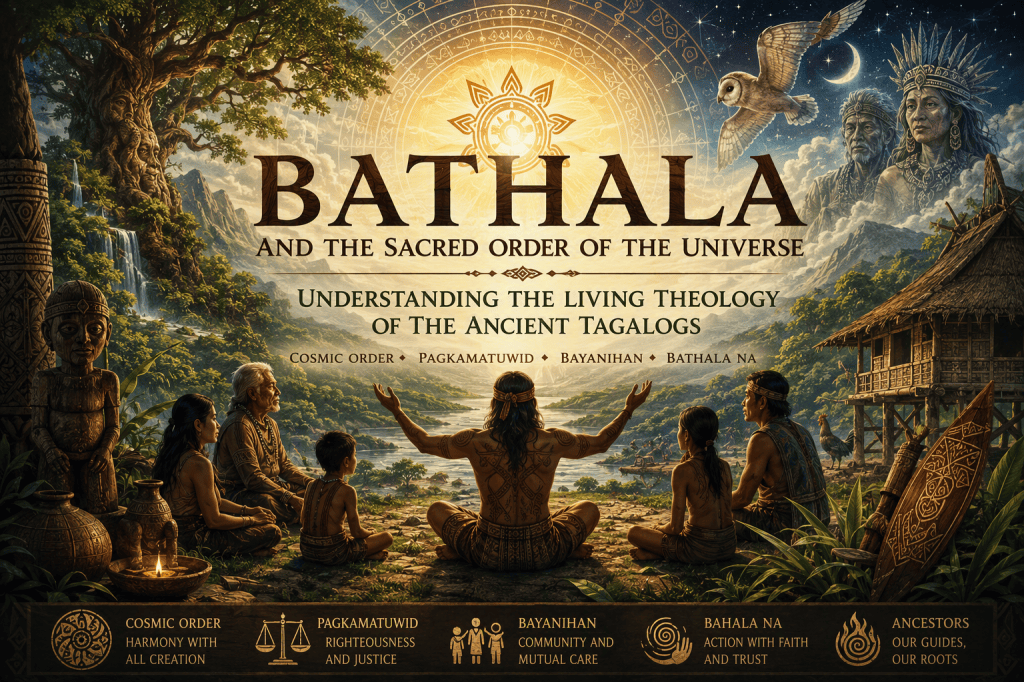
Introduction: Before There Were Sacred Books
When discussing religion, many people instinctively look for a sacred text. Christians have the Bible. Muslims have the Qur’an. Hindus have the Vedas. Buddhists have the Tripitaka.
This often leads some people to ask:
“What was the holy book of the ancient Tagalogs?”
The answer is both simple and profound.
The ancient Tagalogs had no single sacred book comparable to the Bible or Qur’an. Yet this does not mean they lacked divine teachings, spiritual laws, or moral principles. Rather than being written on parchment, stone tablets, or paper, the teachings of Bathala were written into the living fabric of society itself.
Their scriptures were the forests.
Their commandments were the customs.
Their theology was found in the rhythms of nature.
Their sacred laws were preserved in oral traditions, communal memory, and customary practices passed from generation to generation.
In this sense, ancient Filipino spirituality belonged to what modern scholars call a living tradition. Truth was not merely read. It was lived.
The teachings of Bathala were encountered daily through relationships with nature, community, ancestors, and the unseen world.
The First Teaching of Bathala: Cosmic Order
At the heart of ancient Tagalog spirituality is the concept of Cosmic Order.
Before discussing morality, ritual, prayers, or spirits, we must first understand this principle because it serves as the foundation upon which all other teachings stand.
Ancient peoples observed that the universe is not chaotic.
The sun rises in the east and sets in the west.
The moon passes through predictable phases.
The seasons follow recurring cycles.
Seeds become plants.
Children become adults.
Life emerges, matures, dies, and transforms.
Everything follows a pattern.
Everything has a place.
Everything participates in a greater order.
The ancestors understood this order as the work of Bathala.
To them, Bathala was not simply a distant deity who gave occasional commands. Bathala was the source of harmony itself.
The universe exists because Bathala established order where there might otherwise be disorder.
Consequently, the task of humanity is not to dominate creation but to align itself with this sacred order.
Why Fairness Is a Cosmic Principle
One way to understand Cosmic Order is through the principle of sequence.
Consider the simple act of counting:
1 2 3 4 5
The numbers follow one another in proper order.
If we suddenly declare that five comes before one, confusion arises.
If ten is inserted before two, the sequence collapses.
The same principle exists in human society.
A queue functions because people respect order.
When someone cuts in line, conflict emerges.
When favoritism replaces fairness, resentment develops.
When leaders ignore established responsibilities, institutions become unstable.
The ancient worldview recognized that fairness is not merely a social preference.
It reflects the deeper structure of the universe itself.
Everything possesses a rightful place, a rightful relationship, and a rightful time.
Justice exists when these relationships are honored.
Injustice begins when they are violated.
Thus fairness was not merely a human invention.
It was an expression of Cosmic Order.
Humanity as Custodians Rather Than Owners
From this perspective emerges another important teaching.
Human beings are not the owners of creation.
They are its caretakers.
The modern world often treats nature as a resource to be consumed.
Forests become timber.
Rivers become waste channels.
Mountains become sources of minerals.
Animals become commodities.
But the ancient Tagalog worldview was fundamentally different.
Nature was viewed as sacred because it participated in the life established by Bathala.
Every river supported life.
Every mountain preserved balance.
Every forest sheltered countless beings.
Many traditions expressed this understanding through stories of diwata and anito who guarded specific places.
Whether one interprets these beings literally, symbolically, or spiritually, the lesson remains the same:
Nature deserves respect.
When people abuse the earth, they are not merely damaging resources.
They are violating the order of creation.
And every violation eventually returns consequences.
Floods, droughts, environmental collapse, and social suffering are reminders that humanity cannot continually break cosmic balance without consequences.
Pagkamatuwid: The Art of Living in Harmony
The second great teaching of the ancestors may be called Pagkamatuwid.
Pagkamatuwid is often translated as righteousness, but its deeper meaning involves living in proper relationship with reality.
A righteous person is not simply someone who obeys rules.
A righteous person is someone whose thoughts, actions, and intentions align with Cosmic Order.
The ancestors learned this through generations of experience.
They observed patterns.
Truth builds trust.
Trust strengthens community.
Community produces stability.
Stability creates prosperity.
Likewise:
Lies produce suspicion.
Greed creates resentment.
Violence creates fear.
Betrayal destroys relationships.
Thus morality emerged from observation of reality.
The ancestors did not necessarily ask:
“What arbitrary rule should we create?”
Instead they asked:
“What way of living leads to harmony?”
This experiential understanding became the foundation of customary law.
The Law of Cause and Consequence
Many indigenous traditions recognize a principle similar to what modern people call karma.
Among Filipinos, concepts such as gaba, sumpa, and ancestral consequences express this understanding.
The universe remembers actions.
Nothing occurs in isolation.
Everything creates effects.
An act of kindness may inspire another kindness.
A harmful action may generate suffering extending far beyond its original moment.
The ancestors understood morality through this lens.
Goodness was not rewarded simply because a deity arbitrarily decided so.
Goodness produced blessings because it aligned with the structure of reality itself.
Likewise, harmful behavior naturally generated suffering because it opposed that structure.
Pagkamatuwid therefore is not obedience motivated by fear.
It is wisdom guided by understanding.
The Sacred Web of Relationships
Another central teaching of indigenous spirituality is that nothing exists alone.
Everything exists in relationship.
A person is connected to:
- Family
- Community
- Ancestors
- Nature
- Spirits
- Future generations
- Bathala
Modern society often celebrates individual autonomy.
Ancient society emphasized relational responsibility.
A person’s identity was defined not merely by personal achievements but also by the quality of their relationships.
This perspective gave rise to many Filipino values that continue today.
Respect.
Hospitality.
Community solidarity.
Obligation to family.
Generosity.
Compassion.
These are not merely cultural characteristics.
They are spiritual principles.
Why Ancestors Matter
In many modern religious traditions, the dead are often viewed as absent.
The ancient Tagalogs perceived matters differently.
The ancestors remained part of the community.
Their wisdom continued to guide the living.
Their memory preserved identity.
Their stories transmitted values.
To remember the ancestors was therefore an act of gratitude.
A person who forgets their ancestors eventually forgets themselves.
Through ancestral remembrance, each generation remains connected to the accumulated wisdom of all previous generations.
This continuity creates cultural stability and spiritual resilience.
The Deeper Meaning of Bayanihan
Bayanihan is often portrayed simply as community cooperation.
In reality, it reflects a much deeper spiritual truth.
The ancestors recognized that survival depends on mutual support.
No individual can flourish alone.
When one member suffers, the effects ripple throughout the community.
When one member prospers, the benefits can likewise extend to others.
Thus helping others was never viewed solely as charity.
It was participation in Cosmic Order.
One helps because all beings are connected.
One gives because one has received.
One serves because service sustains harmony.
Bayanihan is therefore not merely social cooperation.
It is sacred cooperation.
Reclaiming the True Meaning of “Bahala Na”
Among all indigenous concepts, perhaps none has been more misunderstood than Bahala Na.
Today it is often associated with passivity.
A deeper understanding reveals something entirely different.
The ancient spirit of Bahala Na does not teach surrender before effort.
It teaches trust after effort.
A farmer plants seeds.
A fisherman repairs his nets.
A healer prepares medicines.
A traveler plans the journey.
Each fulfills their responsibility.
Only after every possible action has been taken does one say:
“Bahala Na.”
In other words:
“The rest belongs to Bathala.”
This is not laziness.
This is courage.
It is the recognition that human beings control their actions but not all outcomes.
We work.
We strive.
We prepare.
And then we entrust the results to the Great Order established by Bathala.
The Ultimate Goal: Harmony With All Existence
When all these teachings are brought together, we discover that ancient Tagalog spirituality was fundamentally a path of harmony.
Harmony with self.
Harmony with community.
Harmony with nature.
Harmony with ancestors.
Harmony with spirits.
Harmony with Bathala.
Sin was not merely breaking a rule.
Sin was breaking harmony.
Virtue was not merely obeying a command.
Virtue was participating in harmony.
The ideal human being was therefore someone who lived in balance, respected relationships, fulfilled responsibilities, practiced generosity, protected nature, honored ancestors, and trusted Bathala.
This may be the closest thing the ancient Tagalogs had to a sacred creed.
Not a written list of commandments.
Not a bound volume of scripture.
But a living way of life rooted in the understanding that all existence is interconnected within the sacred order established by Bathala.
And perhaps that ancient lesson remains as relevant today as it was centuries ago:
When humanity forgets Cosmic Order, disorder follows. When humanity lives in harmony with Cosmic Order, the blessings of Bathala naturally flow through all creation.
 Templong Anituhan
Leave a comment