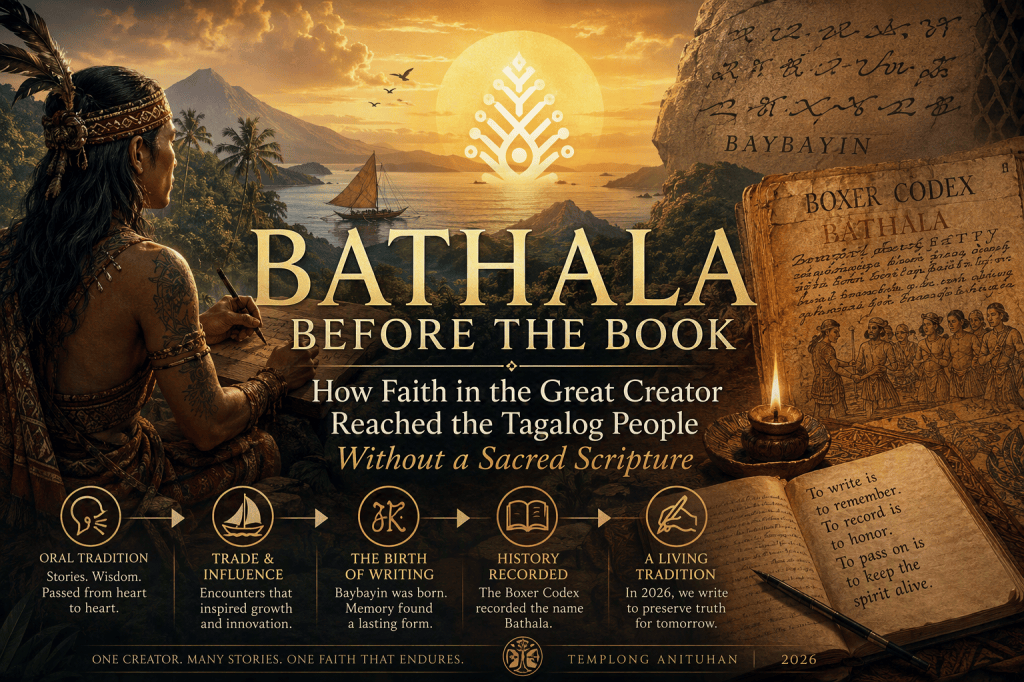
How Faith in the Great Creator Reached the Tagalog People Without a Sacred Scripture
When discussing faith in the modern world, many people immediately think of sacred scriptures. Christians have the Bible. Muslims have the Qur’an. Jews have the Torah. Hindus preserve the Vedas and Upanishads. Buddhists have the Tripitaka and other collections of teachings. These religions possess written texts that serve as repositories of doctrine, history, law, ritual, and spiritual guidance.
Among the Indigenous Tagalog peoples of the Philippines, however, the situation was fundamentally different.
The ancient Tagalogs who inhabited the regions that today comprise Metro Manila, Cavite, Laguna, Batangas, Rizal, Quezon, Marinduque, Oriental Mindoro, Occidental Mindoro, Romblon, Palawan, Bulacan, Bataan, Aurora, and Zambales inherited a spiritual tradition centered upon Bathalang Maykapal, the Great Creator, the Maker, Owner, and Sustainer of all existence. Yet unlike many major world religions, their knowledge of Bathala did not originate from a sacred book.
Indeed, one of the most fascinating questions facing modern students of Indigenous Filipino spirituality is this:
How did faith in Bathala arise and endure without a written scripture?
Faith Before Writing
In Christianity, the Apostle Paul wrote:
“Consequently, faith comes from hearing the message, and the message is heard through the word of Christ.”
Romans 10:17
This passage highlights the importance of transmission. Faith arises because a message is heard, received, and believed.
But what about the ancestors of the Tagalog people?
Long before the arrival of Spanish colonizers, and even before the cultural influence of the Srivijayan trading networks reached the archipelago, the ancient Tagalogs possessed no widespread system of writing. Their wisdom was preserved through memory, storytelling, ritual, poetry, song, and direct experience.
Knowledge passed from elder to youth.
Stories were transmitted around hearth fires.
Teachings were embodied in daily life.
The ancestors did not read about Bathala from a sacred book. They encountered the sacred through existence itself.
The wind spoke.
The rivers taught.
The mountains testified.
The cycles of planting and harvest revealed patterns of blessing and consequence.
Life was their scripture.
Nature was their text.
Experience was their teacher.
The Birth of Writing and the Preservation of Memory
As maritime trade flourished throughout Southeast Asia, the peoples of the Philippine archipelago encountered merchants and travelers from neighboring civilizations. These visitors possessed systems of writing that allowed knowledge to be preserved beyond living memory.
Exposure to foreign scripts inspired local innovation.
Over time, the Tagalogs developed what later became known as Baybayin, a writing system whose roots can be traced to the larger family of Brahmic-derived scripts, including Pallava and Kawi influences that spread throughout Southeast Asia through trade, cultural exchange, and regional interaction.
Writing transformed how knowledge could be preserved.
Memories could now survive the death of the storyteller.
Words could travel beyond the speaker.
History could endure beyond a single generation.
Nevertheless, by the time writing emerged, belief in Bathala was already deeply rooted among the people. Writing did not create Bathala.
Writing merely provided a means to preserve what was already known.
Bathala in the Historical Record
When Spanish colonizers arrived in the Philippines during the sixteenth century, they sought to understand the peoples they intended to govern.
One important source from that era is the Boxer Codex, a late sixteenth-century manuscript prepared to provide information about the inhabitants of the Philippine Islands and neighboring regions for the Spanish Crown.
Among the various observations recorded by Spanish chroniclers was the recognition that the Tagalogs acknowledged a supreme deity known as Bathala.
What is remarkable is not merely that Bathala’s name appears in colonial records.
What is remarkable is that Spanish observers encountered a people who already possessed a concept of a supreme creator before widespread Christianization.
The Boxer Codex did not invent Bathala.
It documented a belief that already existed.
The manuscript serves as evidence that faith in Bathalang Maykapal was alive among the people prior to the complete transformation of the archipelago under colonial rule.
Is Knowing the Name Enough?
A question often arises among modern seekers:
Is knowing the name “Bathala” sufficient to create faith?
The answer is no.
A name alone does not create belief.
One may memorize a divine title and yet remain spiritually untouched.
The ancient Tagalogs did not believe in Bathala simply because someone taught them a word.
They believed because they perceived evidence of a greater reality within the world around them.
Every harvest carried lessons of gratitude.
Every storm inspired humility.
Every birth revealed mystery.
Every death invited reflection.
Blessings and hardships alike became encounters with forces larger than oneself.
From these experiences emerged recognition.
From recognition emerged reverence.
From reverence emerged the name.
Thus, Bathala was not merely a concept.
Bathala was a lived reality.
Myth, Imagination, and Spiritual Truth
Some critics argue that myths and legends are merely inventions. They suggest that stories about Bathala, the Diwata, and the Anito were fabricated by later writers, historians, or cultural enthusiasts.
But this raises a deeper question.
What is imagination?
In contemporary psychology, the mind may be understood as the realm of psyche. Many spiritual traditions understand psyche as inseparable from spirit. Christians themselves proclaim that “God is Spirit.”
If spirit can inspire prayer, prophecy, dreams, insight, and revelation, then must imagination be dismissed as false?
Or might imagination be one of the pathways through which the sacred communicates with humanity?
For many Indigenous spiritual practitioners, imagination is not the opposite of truth.
It is one of the vessels through which truth takes form.
Every vision first appears within consciousness.
Every story begins as an idea.
Every revelation must pass through the human mind before it can be spoken or written.
The existence of imagination does not automatically invalidate spiritual experience.
Rather, it may be one of the very means through which spiritual experience becomes expressible.
The Pen as a Sacred Tool
Today, in the year 2026, I recognize the importance of writing differently than our ancestors once did.
As Punong Binabaylan of Templong Anituhan, I view writing not merely as a means of communication but as a sacred responsibility.
Writing preserves memory.
Writing records experience.
Writing creates continuity between generations.
Writing becomes evidence of who we were and what we believed.
Without written records, much of Indigenous Filipino spirituality was vulnerable to disappearance, fragmentation, or reinterpretation by outsiders.
Therefore, every article, reflection, prayer, ritual guide, and theological discussion written today contributes to the preservation of our spiritual heritage for future generations.
Learning from Other Religions
The Apostle John, while in exile, composed the Book of Revelation, a text filled with imagery, symbols, visions, and prophetic language. For nearly two thousand years, believers have drawn guidance, inspiration, and meaning from those writings.
Whether one interprets Revelation literally, symbolically, historically, or spiritually, the fact remains that its influence emerged because an individual recorded what flowed through his consciousness and experience.
Likewise, the articles, reflections, and teachings being written today within Templong Anituhan emerge from contemplation, spiritual practice, tradition, memory, and lived experience.
These writings do not claim to replace the voices of our ancestors.
Rather, they seek to continue the conversation our ancestors began.
A Living Tradition
The Indigenous Filipino faith has survived not because it possessed a sacred book.
It survived because it possessed living practitioners.
It survived through memory.
It survived through ritual.
It survived through family.
It survived through community.
It survived through experience.
Today we inherit both ancient memory and modern tools.
Our ancestors relied on oral tradition.
We have the opportunity to preserve our knowledge through writing.
If the ancient Tagalogs encountered Bathala through the living world, then we in the present age encounter Bathala through both life and reflection, through both experience and documentation.
The task before us is therefore not merely to remember Bathala’s name.
The task is to continue experiencing the presence of Bathalang Maykapal in our lives and to faithfully record those encounters for future generations.
In doing so, we ensure that the wisdom of our ancestors does not remain trapped in the past but continues to speak to the people of the future.
For faith in Bathala was never born from a book alone.
It was born from life itself.


Leave a Reply