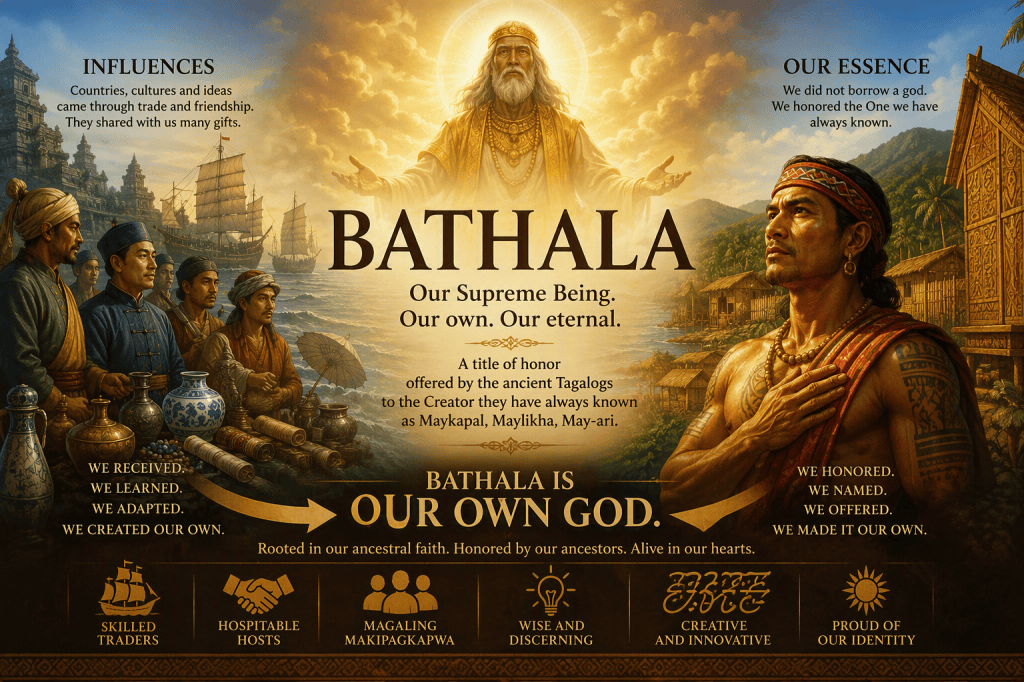
When discussing the origins of the word Bathala, many people immediately focus on its linguistic roots. Scholars have long noted that the term is associated with Sanskrit influence that reached the Philippines through centuries of interaction with neighboring Asian cultures. Yet the story of Bathala is not merely about language. It is also a story about the character of the ancient Tagalogs themselves: their skill in trade, their hospitality, their spirit of pakikipagkapwa (shared humanity), and their remarkable creativity.
Long before the arrival of European colonizers, the ancestors of the Tagalog people were already active participants in regional maritime trade networks. Archaeological and historical evidence shows that communities in the Philippine archipelago were connected to trade routes linking Taiwan, Vietnam, Borneo, China, and other parts of Southeast Asia. These connections existed centuries before the Common Era and expanded further between the 7th and 15th centuries through interactions with the Hindu-Buddhist kingdoms of Srivijaya and Majapahit.
The ancient Tagalogs were not passive observers of these exchanges. They were skilled merchants who understood the value of building relationships. They traded gold, forest products, medicinal plants, resins, beeswax, pearls, shells, and other prized resources. Beyond material goods, however, they also offered something equally valuable: friendship, hospitality, and trust.
Trade in the ancient world was more than a commercial transaction. Successful commerce required the ability to welcome strangers, establish mutual respect, and maintain peaceful relationships with people from different lands. In this sense, the ancient Tagalogs demonstrated the enduring Filipino virtue of pakikipagkapwa. Their openness allowed them to build connections across cultures while preserving harmony within their communities.
In return, foreign merchants brought ceramics, stoneware, luxury textiles, metal tools, pigments, glass beads, umbrellas, writing materials, and many other products that enriched local life. Along with these goods came new ideas, technologies, artistic influences, and words that gradually became part of the local vocabulary.
Some people may view this cultural exchange as imitation. However, such a view misunderstands the creative genius of our ancestors.
The ancient Tagalogs were not simply copying foreign cultures. Instead, they possessed the wisdom to recognize useful ideas and the creativity to transform them into something uniquely their own. They adapted foreign influences according to local needs, values, and experiences.
A clear example of this process is the development of indigenous writing systems such as Baybayin. Before writing became widespread, knowledge was preserved and transmitted through oral traditions, songs, chants, genealogies, and ritual teachings. As trade and cultural interactions expanded, the need for written communication grew. Rather than merely reproducing foreign scripts, local communities adapted writing technologies and developed forms that suited their own languages and way of life. The result was a distinctly Philippine writing tradition.
The story of the word Bathala follows a similar pattern.
The term is often understood as having roots connected to Sanskrit honorific concepts that entered the archipelago through centuries of cultural exchange. Yet for the ancient Tagalogs, Bathala was not simply a borrowed word. It became an expression of local spirituality and devotion.
Before the widespread use of the title Bathala, the Supreme Being was already known by names and descriptions such as Maykapal (Creator), Maylikha (Maker), and May-ari (Owner or Sovereign). As trade brought new concepts and honorific titles from neighboring cultures, the Tagalogs found a meaningful way to incorporate them into their own worldview.
We might compare this to the modern practice of addressing respected individuals by their titles: Mayor, General, President, Doctor, or Reverend. These titles do not replace a person’s identity; rather, they express honor and recognition.
In the same way, the ancient Tagalogs appear to have embraced Bathala as an honorific title worthy of the Supreme Creator they already revered. It was a gift of language that they offered back to the Divine. Thus emerged the expression Bathalang Maykapal—the Lord Creator.
This reveals something profound about the character of the ancient Tagalogs. They were neither isolated nor closed to the world. They were confident enough to engage with foreign cultures, wise enough to discern what was beneficial, and creative enough to transform outside influences into something distinctly their own.
The history of Bathala therefore teaches us more than the origin of a word. It reminds us that our ancestors were accomplished traders, generous hosts, and builders of relationships. They practiced pakikipagkapwa not as a slogan but as a way of life. Their openness to others did not weaken their identity; it strengthened it.
The greatness of the ancient Tagalogs was not found in isolation, but in their ability to welcome new ideas, adapt them with wisdom, and create something uniquely Filipino. The word Bathala stands as a lasting symbol of that journey: a testament to a people who were hospitable, innovative, and deeply connected to both the world around them and the Divine they called Maykapal.
Author’s Reflection
Perhaps the true lesson of our ancestors is this: cultural exchange does not diminish identity. When guided by wisdom, creativity, and pakikipagkapwa, it becomes a path toward enrichment and growth. The ancient Tagalogs did not merely borrow from others. They transformed what they received into something that reflected their own soul, values, and vision of the sacred.


Leave a Reply