Introduction
When discussing the ancient religion of the Tagalog people, the name Bathala is often recognized as the supreme deity of precolonial Tagalog belief. However, a deeper exploration of history raises an intriguing question:
What did the ancient Tagalogs call the Supreme Creator before the title Bathala became widespread?
Long before the arrival of Hindu-Buddhist influences from the Srivijaya Empire, Islamic teachings from the southern trade routes, and Christianity through Spanish colonization, the ancestors of the Tagalog people already possessed a rich spiritual worldview rooted in nature, ancestry, community, and reverence for a Supreme Creator.
This article explores the evolution of that belief and the historical journey of the name by which the Tagalog people understood the Divine.
Who Were the Ancient Tagalogs?
The Tagalogs belong to the larger Austronesian family of peoples who began migrating into the Philippine archipelago around 2200 BCE. Skilled navigators and settlers, they established communities throughout Luzon, particularly along rivers, lakes, and coastal regions.
The term Tagalog is commonly understood to mean “people from the river” (taga-ilog), reflecting the importance of waterways in their daily lives.
Ancient Tagalog society consisted of independent communities known as barangays, each led by a datu. These communities maintained their own customs, laws, and leadership structures while engaging in trade and alliances with neighboring settlements.
Their livelihood centered upon:
- Agriculture
- Fishing
- Hunting
- Weaving
- Pottery
- Maritime trade
As Austronesian peoples, the Tagalogs developed a worldview deeply connected to the natural world, seeing the sacred not as separate from life but woven into every aspect of existence.
The Indigenous Spirituality of the Ancient Tagalogs
Before foreign religious influences became widespread, the spiritual tradition of the Tagalogs was fundamentally animistic.
They believed that the universe was alive and filled with spiritual presence.
Their spiritual world included:
- Ancestral spirits (Anito)
- Nature spirits
- Diwata or divine beings
- Guardians of specific places
- A Supreme Source of all existence
The natural world was not viewed merely as a physical environment but as a sacred landscape inhabited by visible and invisible beings. Mountains, rivers, forests, rocks, and even the winds carried spiritual significance.
For the ancient Tagalogs, spirituality was not confined to rituals alone. It was expressed through respect for nature, reverence for ancestors, communal harmony, and gratitude toward the source of life.
The Creator Before Bathala
One of the most fascinating questions in the study of Tagalog spirituality concerns the identity and name of the Supreme Creator before the widespread use of the title Bathala.
Many scholars and cultural researchers suggest that ancient Austronesian-speaking peoples already possessed concepts of a high creator god long before Hindu-Buddhist influences entered the Philippines.
Among indigenous Tagalog concepts are titles such as:
- Maykapal (The Creator)
- Maylikha (The Maker)
- May-ari (The Owner or Sovereign)
- Poong Maykapal (Lord Creator)
Unlike Bathala, these words are rooted directly in native Austronesian language traditions.
Their meanings reveal fundamental theological concepts:
- Maykapal – The One Who Created All Things
- Maylikha – The Divine Maker
- May-ari – The Source and Owner of Creation
From this perspective, the idea of a Supreme Creator may have existed among the Tagalogs long before the adoption of the title Bathala.
In other words, the Creator may have been known first through descriptive titles based on divine functions rather than through a specific personal name.
The Arrival of Srivijayan Influence and the Emergence of Bathala
Between the 7th and 13th centuries CE, the maritime empire of Srivijaya, centered in present-day Sumatra, became a dominant force in Southeast Asian trade and culture.
Its influence spread primarily through:
- Commerce
- Cultural exchange
- Maritime networks
- Religious interaction
Unlike military conquest, Srivijaya’s impact on the Philippines largely came through peaceful trade relations.
Along with goods and ideas came Sanskrit vocabulary and religious concepts.
One Sanskrit word often connected with the development of the term Bathala is:
Bhaṭṭāra
meaning:
- Lord
- Noble One
- Exalted Ruler
Over time, this title may have been adapted into the Tagalog word Bathala.
Viewed through this lens, Bathala was not necessarily a completely new deity introduced from abroad. Rather, it may have become an honorific title applied to the already existing concept of the Supreme Creator.
Thus, one may understand the transition as:
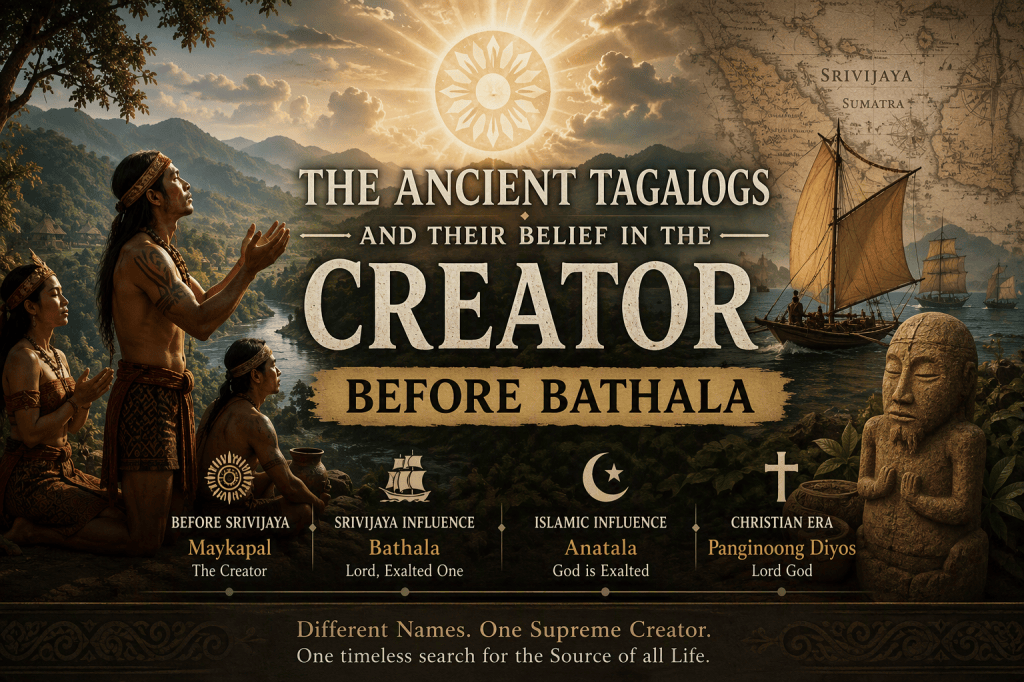
Maykapal as the original concept of the Creator, and Bathala as the later title of exaltation.
In a similar way, different cultures use titles such as:
- Lord God
- Yahweh
- Allah
- Great Spirit
- Heavenly Father
to refer to the Supreme Divine Reality.
From Bathala to Anatala
By the late thirteenth and fourteenth centuries, Islamic influence began reaching various parts of the Philippine archipelago through trade networks connecting the region with Brunei, Sulu, Malaysia, Indonesia, and the wider Muslim world.
As cultural interaction increased, new ways of speaking about the Divine also emerged.
Some researchers and oral traditions point to forms such as Anatala as possible expressions influenced by Islamic language and ideas.
Within Islamic tradition, one of the most common expressions of reverence for God is:
Subhanahu wa Ta’ala
which means:
“Glorious is He, the Most High.”
Whether or not Anatala developed directly from this phrase remains a subject for further historical study. Nevertheless, it reflects the long-standing interaction between indigenous Tagalog spirituality and Islamic influences throughout maritime Southeast Asia.
The Christian Era
The arrival of Spanish missionaries in the sixteenth century introduced Christianity to the Philippines.
Rather than completely replacing indigenous terminology, many missionaries adopted existing Tagalog concepts when explaining Christian teachings.
As a result, expressions such as:
- Bathalang Maykapal
- Panginoong Diyos
- Poong Maykapal
became increasingly common.
Through this process, the precolonial understanding of a Supreme Creator merged with Christian theology, allowing indigenous concepts to survive within a new religious framework.
Divine Mercy and Contemporary Filipino Spirituality
During the twentieth century, particularly from the 1980s onward, the devotion to the Divine Mercy became widespread among Filipino Catholics.
For many Filipinos, Christ as Divine Mercy naturally resonated with the older understanding of Bathalang Maykapal as a compassionate and loving Lord.
Across different periods of history, the Divine has been approached through various names:
- Maykapal
- Bathala
- Anatala
- Panginoong Diyos
Yet each reflects the continuing human search for the highest source of life, wisdom, compassion, and creation.
Looking Back to Move Forward
The study of ancient Tagalog religion reminds us that our ancestors did not begin without spirituality. Long before foreign faiths arrived on Philippine shores, they possessed a sophisticated understanding of the sacred, grounded in nature, community, ancestry, and the mystery of creation itself.
The names may have changed throughout the centuries:
Maykapal. Bathala. Anatala. Lord God.
Yet the enduring quest remains the same: humanity’s search for the Ultimate Source of Life and Meaning.
By rediscovering the spiritual heritage of the ancient Tagalogs, we gain a deeper appreciation not only of our history but also of the enduring wisdom that continues to shape Filipino identity today.
“To understand where we are going, we must first remember where we came from. In honoring the spiritual legacy of our ancestors, we rediscover the roots of our own sacred journey.”


Leave a Reply