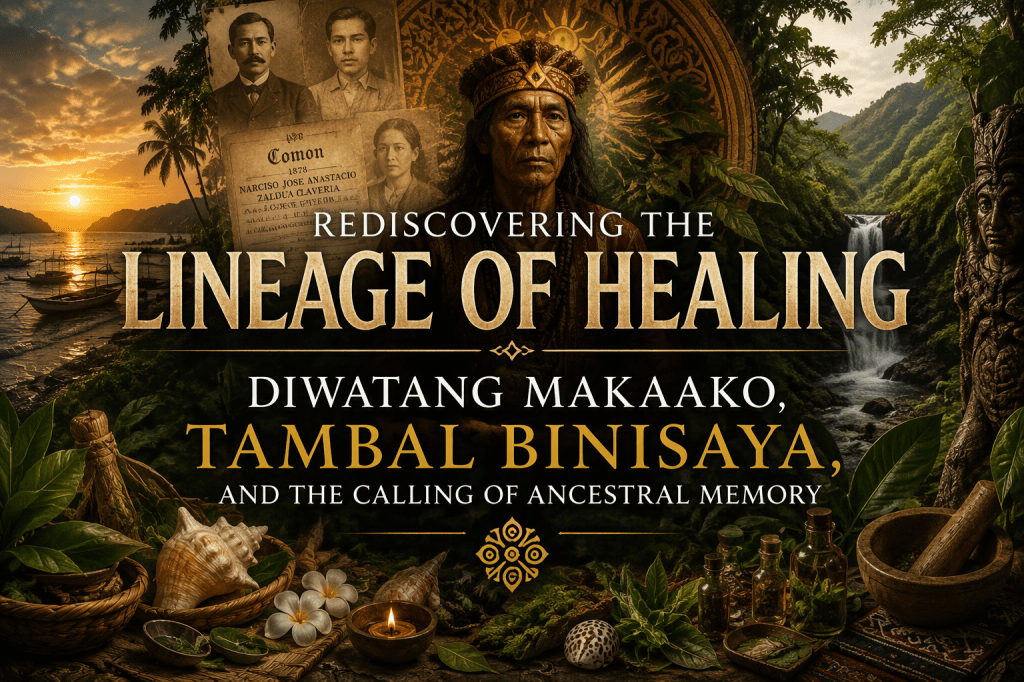
Since the New Moon of July 14, 2026, a profound journey of remembrance has unfolded before me.
As part of our sacred observance within Templong Anituhan Inc., we stood before the Council of the Diwata and sought guidance regarding the spiritual guardian who would accompany our community for the next cycle of growth. It was then that Diwatang Makaako of the Kinaray-a People stepped forward.
At first, I felt that Makaako was simply continuing the work left by Diwatang Pawi of the Agta People, whose teachings emphasized rooting ourselves deeply into the earth, cultivating wisdom, and allowing our plans to grow like living plants. Yet as the weeks passed, I realized that Diwatang Makaako had something more personal to reveal.
Rather than leading me toward a new destination, Makaako guided me back toward my origins.
Remembering the Lineage
The journey began with the memory of my paternal grandfather, Diomedes Paqueo Comon Sr., a respected Tambal Binisaya practitioner from Barangay Esperanza in Del Carmen, Siargao Islands, Surigao del Norte.
As I reflected upon his life and legacy, a deeper curiosity emerged regarding our family history. This eventually led me to trace our ancestral lineage further back into the nineteenth century.
Through this exploration, I encountered records identifying Osias Comon, married to Honorata Plandano, as among the earliest documented bearers of the Comon surname within our family line. Their descendants would continue the family legacy through generations, including Flaviano Plandano Comon (1912-1950).
My reflections also brought me to Galo C. Comon, who served as the first mayor of the newly established Municipality of Del Carmen from 1964 to 1967, and who holds a significant place in the civic history of our ancestral homeland.
As I contemplated these stories, a common thread became visible.
The name Comon seemed repeatedly connected to individuals who brought transformation and service to their communities.
Some served through governance.
Others served through healing.
Today, I serve through Hilot, education, ministry, and indigenous spirituality.
The realization was both humbling and inspiring.
The Grandson of a Tambal Binisaya
Although I was born and raised far from Siargao, growing up in Manila and later Bulacan, I increasingly sensed that my connection to my ancestral homeland had never truly disappeared.
I do not speak the Visayan language fluently. My daily life has been shaped primarily by Tagalog and English. Yet despite the distance in geography and language, the bloodline remains.
The wisdom remains.
The calling remains.
Through the guidance of Diwatang Makaako, I felt encouraged to embrace more fully my identity as the grandson of Diomedes Paqueo Comon, a healer whose knowledge was rooted in the traditions of Tambal Binisaya.
What I once viewed merely as family history began revealing itself as an ancestral inheritance.
The Richness of Tambal Binisaya
As this process unfolded, I found myself reflecting more deeply upon the healing traditions practiced by my grandfather and many Visayan healers before him.
Tambal Binisaya is not merely traditional medicine. It is a holistic system that integrates physical healing, energy work, spirituality, ecological awareness, and community responsibility.
Among its major modalities are:
1. Pagpanghimatmat
Traditional Diagnostics
A method of observation, listening, intuition, and assessment used to understand the source of imbalance affecting a person.
2. Hilot Binisaya
Somatic and Energy-Based Healing
The therapeutic use of touch, manipulation, and energetic awareness to restore balance and wellness.
3. Panghugas ug Pamalut
Herbal Medicine
The preparation and application of medicinal plants, oils, washes, and natural remedies.
4. Pag-orasyon
Sacred Words and Spiritual Invocation
The use of prayers, chants, spoken blessings, and sacred utterances in healing work.
5. Pabuhat ug Pagbawi
Ritual Offerings and Restoration
Ceremonial acts intended to restore harmony between human beings, ancestors, nature, and the unseen world.
As I learned more about these practices, I became increasingly amazed by the depth of knowledge preserved by generations of Visayan healers.
Tambal sa Sudong: Healing and Protection of the Waters
One discovery that particularly fascinated me was the existence of Tambal sa Sudong, a specialized branch of Tambal Binisaya dedicated to the marine world.
This tradition concerns spiritual protection and healing connected to coastal waters, mangrove forests, intertidal ecosystems, and the unseen forces believed to dwell within them.
For island communities such as those of Siargao, the sea is not merely a source of food or livelihood. It is also a sacred realm interconnected with ancestral memory, ecological balance, and spiritual responsibility.
Baliw and Gaba: Lessons in Sacred Accountability
Another profound aspect of the Visayan healing tradition involves the concepts of Baliw and Gaba.
Baliw is traditionally understood as a condition resulting from offenses against the unseen world, particularly when sacred places, spirits, or natural environments are violated. Such disturbances may manifest as physical, emotional, or spiritual imbalance.
Even more striking is the concept of Gaba.
Gaba is understood as a form of cosmic consequence or universal retribution resulting from grave wrongdoing. Unlike ordinary illness, Gaba is not considered something that can simply be removed by a healer.
No babaylan, mananambal, maaram, or daetan can erase its effects through ritual alone.
Instead, restoration requires personal accountability, sincere correction, reconciliation, and ethical action by the one who caused the harm or their family.
This teaching reveals a profound indigenous understanding of justice.
Healing is not merely about curing symptoms.
Healing is also about restoring right relationship.
From Ancestral Memory to Earth Stewardship
As these discoveries unfolded, another realization emerged.
The lessons of Diwatang Makaako were not limited to genealogy or traditional healing.
They also pointed toward stewardship of the Earth.
Today, the Philippines faces many environmental challenges: drought, concerns regarding water security, the protection of critical ecosystems such as the Sierra Madre and Sibuyan Island, and ongoing debates regarding development and ecological sustainability.
In many indigenous traditions, the role of the healer extends beyond caring for individual people.
The healer also cares for the land.
The rivers.
The forests.
The mountains.
The oceans.
This understanding reminded me of modern indigenous leaders such as the late Bai Bibyaon Estrella Bangotbanwa, whose work embodied both spiritual leadership and advocacy for her people and their ancestral lands.
Perhaps this is one of the messages Makaako wishes to emphasize during this cycle: that healing the people and healing the Earth are inseparable responsibilities.
A Continuing Journey
What amazes me most is that Diwatang Makaako has allowed me to experience personally the kind of transformational journey that we often seek to facilitate for our students through Hilot Academy of Binabaylan and Luntiang Aghama.
In a relatively short period, I have been guided into a deeper understanding of my ancestry, my vocation, and the healing traditions carried by my forebears.
Yet I recognize that this is only the beginning.
There is still much to study.
Much to understand.
Much to document.
And much to share.
I pray that I may continue to learn from the legacy of my grandfather, Diomedes Paqueo Comon, and from the wisdom of the Tambal Binisaya tradition that helped shape our family lineage.
For in remembering our ancestors, we do not merely look backward.
We discover the roots that allow us to grow forward.
Padayon.
May the memory of the ancestors guide our path, and may our healing bring honor to the land, the people, and the generations yet to come.
 Templong Anituhan
Leave a comment