By Rev. Rolando Gomez Comon (Apu Adman)
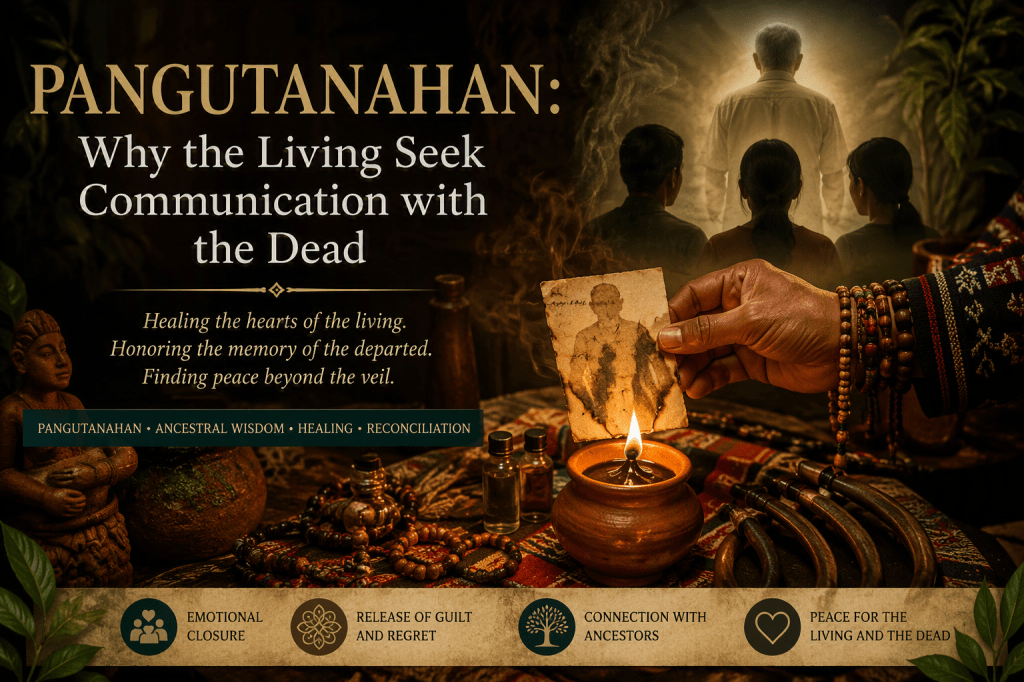
Listening Beyond the Veil: The Healing Purpose of Pangutanahan
On many occasions in my work as a Binabaylan, I have encountered people carrying a burden that medicine cannot cure, wealth cannot remove, and time alone cannot always heal. It is the burden of unfinished relationships with those who have passed on.
Many people assume that communication with the dead is centered on curiosity, supernatural phenomena, or the desire to witness extraordinary manifestations. Yet among our ancestors, the purpose was often much simpler and more profound: healing the hearts of the living and allowing the departed to continue their journey in peace.
Among traditional practices found throughout the Philippines, forms of spirit communication were known by various names. In some communities, one such practice is called Pangutanahan or Pangatauhan, a ritual process through which questions are brought before a spirit, ancestor, or departed loved one through the mediation of a gifted ritual specialist, healer, or Babaylan.
Far from being an act of entertainment, Pangutanahan traditionally served as a sacred conversation between memory, spirit, and community.
Why People Seek Communication with Their Dead Loved Ones
The death of a loved one often leaves more than grief.
It leaves unanswered questions.
“Did my father forgive me?”
“Was my mother happy in her final moments?”
“Did my brother know I loved him?”
“Why did he leave without saying goodbye?”
When a person dies abruptly, or when family members are separated by distance, conflict, migration, illness, or other circumstances, emotional wounds often remain unresolved.
Many people seeking Pangutanahan are not searching for proof of life after death.
They are searching for peace.
They seek reassurance that love remains stronger than physical separation. They seek understanding of events that could not be discussed while their loved one was alive. Most importantly, they seek permission to release guilt, regret, and self-blame.
The Babaylan as a Bridge
In traditional Filipino spirituality, the Babaylan occupies a unique role.
The Babaylan is neither the source of the message nor its owner.
Rather, the Babaylan acts as a bridge between worlds.
The role of the spiritual intermediary is not to impose personal opinions, but to create a sacred space in which communication may occur. Through prayer, ritual, invocation, divination, chanting, dreams, symbols, or other sacred methods, the Babaylan assists in bringing forth what needs to be heard.
From my perspective, communication with the departed does not always mean speaking with a spirit in the manner portrayed by movies or television.
Often the process is much more subtle.
The messages emerge through symbols, emotions, memories, images, impressions, and sacred insights. Frequently, the living already carry these truths within themselves, consciously or unconsciously. The ritual merely opens a pathway through which those truths may be recognized and spoken.
The Healing Function of Pangutanahan
One of the most important benefits of Pangutanahan is emotional release.
In Hilot Binabaylan, unresolved emotions can create disharmony within a person’s physical, psychological, social, and spiritual dimensions. Grief held for years can become a heavy burden that affects relationships, health, and personal growth.
When communication brings understanding, several healing processes may occur:
1. Release of Guilt
Many individuals carry guilt after the death of a loved one.
They believe they should have visited more often, called more frequently, or been present during the final moments.
Receiving reassurance through ritual may help them acknowledge their regrets, seek forgiveness, and begin the process of self-healing.
2. Emotional Closure
Death sometimes interrupts important conversations.
Pangutanahan provides an opportunity for symbolic closure, allowing words of love, apology, gratitude, and farewell to be expressed.
3. Strengthening Family Bonds
Many spirit communication sessions involve more than one family member.
Shared grief can divide families, but shared healing can reunite them.
When siblings, parents, or relatives participate together, they often discover that they have been carrying similar emotional burdens.
4. Continued Relationship with Ancestors
In Indigenous Filipino spirituality, death is not necessarily the end of a relationship.
The ancestors continue to be remembered, honored, and consulted.
Pangutanahan reinforces the understanding that our loved ones remain part of our spiritual lineage and collective memory.
5. Acceptance of Death
Perhaps the greatest healing comes when the living finally accept that physical death has occurred.
Acceptance does not mean forgetting.
Acceptance means allowing love to remain while letting suffering transform into remembrance.
The Role of Diwatang Makaako
Within the tradition of Templong Anituhan, Diwatang Makaako is recognized as a Diwata associated with knowledge, memory, insight, and understanding.
When called upon during Pangutanahan, Diwatang Makaako serves as a witness and guide in the search for truth and reconciliation.
The purpose is not to disturb the departed but to create an atmosphere of wisdom, compassion, and clarity in which healing may occur.
Through the guidance of the Diwata, the living are encouraged to listen not only to the messages that emerge but also to the lessons carried within those messages.
Beyond the Dead: Healing the Living
The greatest misconception about communicating with the dead is that it is primarily for the dead.
In reality, it is often for the living.
The departed have already crossed into another state of existence according to the beliefs of their tradition. It is the living who remain carrying unanswered questions, emotional pain, and unfinished stories.
When performed with reverence, sincerity, and proper spiritual intention, Pangutanahan becomes a ritual of healing rather than a spectacle of supernaturalism.
Its true purpose is not to prove that spirits exist.
Its true purpose is to help the living find peace.
Conclusion
Across the centuries, Filipino ancestral traditions have preserved many ways of remembering and honoring those who have passed on. Pangutanahan is one such sacred practice, reminding us that grief is not only about loss but also about love.
Whether through prayer, ritual, dreams, memory, or sacred communication, the voices of our departed loved ones continue to shape our lives.
Perhaps the greatest gift of Pangutanahan is not the message itself.
Rather, it is the moment when tears become understanding, guilt becomes forgiveness, and grief becomes peace.
For in the end, the deepest healing occurs when both the living and the departed are finally allowed to rest within the embrace of love.
Seeking Healing Through Pangutanahan?
There are moments in life when grief remains unresolved, questions remain unanswered, and the heart continues to search for peace after the passing of a loved one.
Pangutanahan is not intended to replace faith, counseling, or the natural process of mourning. Rather, it is offered as a sacred space for reflection, remembrance, reconciliation, and spiritual healing. Through prayer, ritual, divination, and guided ancestral communication within the Binabaylan tradition, participants are given the opportunity to express what remains unspoken and to receive insight that may help bring comfort and understanding.
If you feel called to seek healing through Pangutanahan, you are welcome to contact us for an initial consultation.
Available Services
✅ Online Pangutanahan Session
✅ In-Person Pangutanahan Session
✅ Family Reconciliation and Ancestor Healing Sessions
✅ Individual Grief and Spiritual Guidance
✅ Memorial and Ancestral Remembrance Rituals
Sessions are conducted by appointment only to ensure adequate preparation, prayer, and spiritual discernment.
Whether you are seeking answers, closure, forgiveness, or simply a sacred space to honor the memory of a departed loved one, we will journey with you in compassion, respect, and reverence.
Schedule an Appointment
To inquire about Pangutanahan or to schedule an online or in-person session, please send us a private message through our official pages or contact us directly.
Hilot Academy of Binabaylan
Templong Anituhan ng Luntiang Aghama
San Jose del Monte City, Bulacan, Philippines
“For the departed, we offer remembrance. For the living, we offer healing. For both, we offer peace.”
Author’s Reflection
As a practicing Binabaylan, I have come to understand that Pangutanahan is rarely about speaking with the dead. More often, it is about helping the living rediscover love beyond regret, forgiveness beyond guilt, and peace beyond loss. In the wisdom of our ancestors, death does not end relationship; it transforms it. Through remembrance, prayer, and sacred listening, we continue to walk with those who have gone before us, carrying their lessons, their love, and their blessings into the future.
Rev. Rolando Gomez Comon (Apu Adman)
Punong Binabaylan
Templong Anituhan ng Luntiang Aghama
Hilot Academy of Binabaylan


Leave a Reply