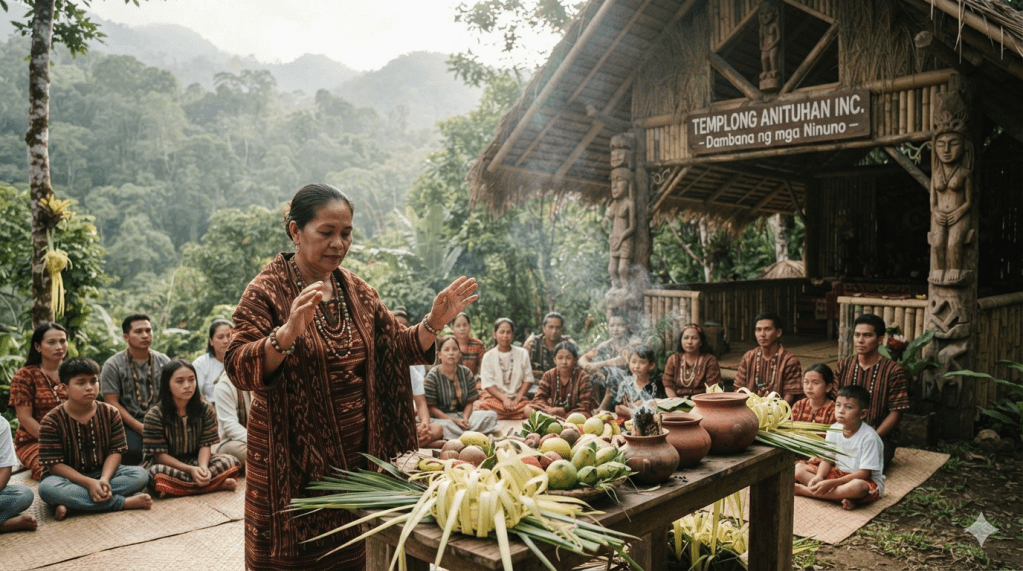
In a nation where religious identity is overwhelmingly defined by mainstream monotheistic institutions, a quiet but profound shift is occurring within the landscape of Filipino spirituality. Templong Anituhan Inc. (formerly registered as Luntiang Aghama Natural Divine Arts Shrine of Healing Inc.) stands out as a unique legal and spiritual institution in the Philippines.
Registered with the Securities and Exchange Commission (SEC), it is a non-stock, non-profit religious organization dedicated entirely to the revival, systematization, and contemporary practice of Anitismo—the indigenous animist spirituality of the Philippine archipelago.
Templong Anituhan is not merely an alternative among many religious options; it represents a radical departure from both mainstream Western-centric churches and sensationalized modern pagan movements.
1. Monotheistic Hegemony vs. The Living Ecosystem
The most profound distinction between Templong Anituhan and mainstream religious organizations lies in their fundamental worldview.
- Mainstream Paradigms: Most dominant religions in the Philippines operate on a hierarchical, vertical model of salvation. Divinity is localized in a distant heaven, humanity is viewed as fallen, and nature is often treated as a resource to be dominated or a fallen realm to be transcended.
- The Anituhan Framework: Templong Anituhan operates on a horizontal model of kinship. Divinity is immanent, woven entirely into the fabric of the natural world. They do not teach a doctrine of sin and salvation. Instead, they promote a theology of harmony and alignment. The universe is viewed as a vibrant, living spiritual ecosystem where humans, ancestors (Anito), and nature spirits (Diwata and Engkanto) are interconnected threads of a singular Divine Source (Bathala).
2. Rejecting Pop-Occultism for Theological Dignity
While contemporary expressions of “folk magic” or internet-era witchcraft (Kulam) often rely on dark aesthetics, shock value, or imported Western occult systems (like Wicca), Templong Anituhan approaches indigenous spirituality with academic and etymological rigor.
- Austronesian Roots: The organization actively rejects the vulgarization of animism. The very name Anituhan is a deliberate synthesis of Anito (ancestral soul/spirit) and Tuhan (the ancient Austronesian root word for God/Lord). By using this terminology, the temple bridges the gap between decentralized folklore and structured theological philosophy.
- Ethics of Gentle Deference: Unlike performative movements that project aggressive, counter-cultural personas, Templong Anituhan anchors its practices in traditional Filipino virtues: Modestya (Modesty), Kabaitan (Kindness), and Paggalang (Politeness). This mirrors the soft-spoken respect of ancestral healers who never commanded nature, but rather humbly requested permission (“tabi-tabi po”) to walk through its spaces.
3. Academic Structure via Diwatahan Studies
Historically, Anitismo was passed down purely through oral traditions and localized bloodlines, making it vulnerable to colonial erasure and fragmented folklore. Templong Anituhan addresses this vulnerability by building a systematic educational framework.
Through its structured Diwatahan Studies, the temple maps out the spiritual geography of the Philippines into specific regional realms—such as the mountain ranges of the Sierra Madre, the heights of the Cordilleras, and the deep Visayan waters. Rather than relying on vague, generalized spells, seekers (Pithaya) study the historical, cultural, and ecological contexts of specific deities and ancestral lineages. It treats animism not as a primitive superstition, but as an ancient science of relational living.
                  [ BATHALA ] (The Divine Source)
                       │
         ┌─────────────┴─────────────┐
         ▼                           ▼
    [ DIWATA ]                  [ ANITO ]
(Natural Intelligences)    (Ancestral Lineages)
         │                           │
         └─────────────┬─────────────┘
                       ▼
             [ SYSTEMATIC REALMS ]
    (Sierra Madre • Cordillera • Visayan Waters)
                       │
                       ▼
             [ DIWATAHAN STUDIES ]
          (Formal Academic Curriculum)
4. Reconceptualizing Spiritual Authority and Healing
In mainstream religious structures, spiritual authority is heavily centralized, dogmatic, and often institutionalized through a male-dominated priesthood. Templong Anituhan intentionally decentralizes this power while maintaining strict ethical guardrails.
The temple serves as a formal sanctuary for the ordination and recognition of traditional spiritual practitioners, including the Binabaylan (spiritual intermediaries) and Albularyo (folk herbalists/healers). Here, spiritual authority is measured by an individual’s capacity to facilitate holistic, psycho-emotional, and physical well-being through traditional arts like Hilot (energetic bodywork) and Tawas (indigenous divination). Authority is not derived from dogmatic control, but from an individual’s demonstrated alignment with the community and the natural world.
5. Institutional Legitimacy as De-Colonial Rebirth
Perhaps the most pragmatic indicator of Templong Anituhan’s uniqueness is its institutional framework. By navigating the secular legalities of the Securities and Exchange Commission, the temple has claimed formal, juridical legitimacy for Anitismo within the modern Philippine state.
For centuries, indigenous beliefs were classified under colonial law as heresy, witchcraft, or subversion. By securing corporate status as a recognized religious body, Templong Anituhan removes the practice from hidden, underground spaces and places it firmly in the public square. This legal framework ensures that the veneration of pre-colonial ancestors is afforded the same institutional protections, dignity, and structural permanence as any global religious denomination.
A Temple of Remembrance
Templong Anituhan Inc. is more than a religious alternative; it is an act of institutional decolonization. By rejecting the commercialization of modern spiritual trends and resisting the dogmatic hierarchies of mainstream faiths, it offers a distinct, intellectually rigorous path. It stands as a sanctuary where modern Filipinos can legally, safely, and deeply remember the oldest relationship they have ever had: the sacred bond between human community, ancestral memory, and the living earth.


Leave a Reply