By Rev. Rolando Gomez Comon (Apu Adman)
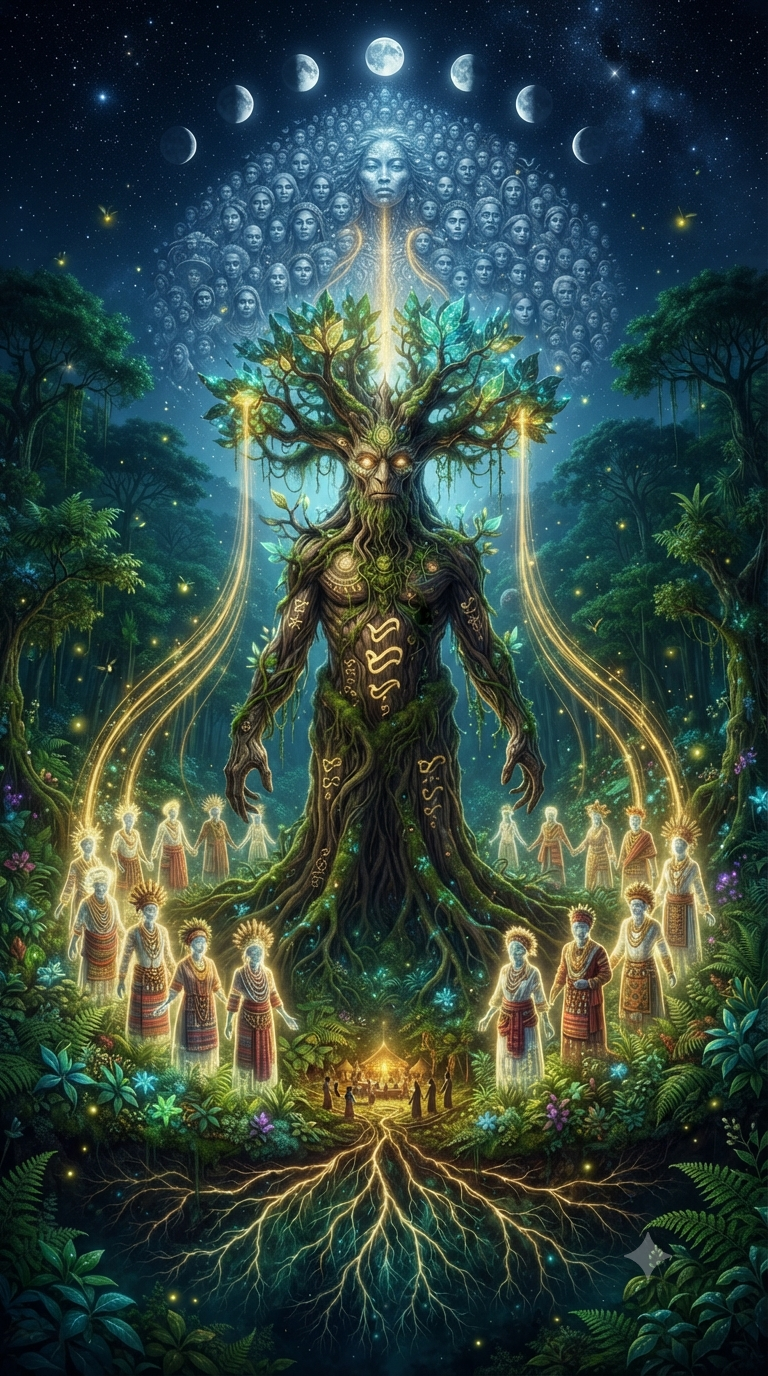
As the current lunar cycle approaches its conclusion and the New Moon draws near, I find myself reflecting upon the presence of Pawi, whom I have come to honor as the Guardian of the Forest and protector of our Temple during this season.
To be honest, I have never fully seen Pawi’s face in my mind. His form remains mysterious. Yet when I try to imagine him, my thoughts naturally turn to the tree-being Groot from Guardians of the Galaxy. Like Groot, I perceive Pawi as ancient, patient, quiet, and deeply rooted in the wisdom of the Earth. Through this image, I have found a way to understand the lessons that Pawi seems to be teaching me.
Recently, while watching Avatar: The Last Airbender on Netflix, I was struck by a scene where Aang meditates and realizes that he is a bridge between spirits and humanity, carrying within himself the presence and wisdom of those who came before him. The moment touched something deep within me.
As I reflected on that scene, I felt a renewed calling to study and invoke the memory of the ancient Babaylan of our people.
For years, I have already included the names of ancestral Babaylan in my devotional prayers, beginning with Babaylan Karyapa. More recently, I have begun writing articles about them so that future generations may remember their sacrifices and their efforts to preserve the indigenous spiritual traditions of our ancestors during times of colonization and cultural change.
What surprised me was the realization that these events may not be separate from the teachings of Pawi.
The image of a forest spirit, the meditation of Aang, the remembrance of the Babaylan, and even the simple act of propagating a Lagundi plant all seem connected by a single lesson:
Roots.
On June 22, I started a stem cutting of Lagundi. Day after day, nothing remarkable appeared on the surface. Yet beneath the stem, unseen roots were beginning to form. Today, new growth has emerged.
That small plant has become a living teaching.
Before a plant can grow upward, it must grow downward.
Before branches can reach toward the sky, roots must reach into the earth.
Before a faith can flourish, it must know where it comes from.
Perhaps this is what Pawi has been teaching me all along.
Templong Anituhan is still young in many ways. Like the Lagundi cutting, it is establishing its roots. The work of documenting prayers, preserving teachings, creating rituals, training clergy, building educational programs, honoring the Diwata, remembering the Anito, and reconnecting with the wisdom of the Babaylan are not merely administrative tasks.
They are acts of rooting.
A tree without roots falls in the first storm.
A tradition without memory disappears in the first generation.
A spiritual movement without structure rarely survives its founder.
Pawi, as the spirit of the forest, seems to remind us that longevity comes not from speed but from depth.
The greatest trees in the forest do not become great overnight. They survive because their roots spread far beyond what others can see.
In the same way, the future of Templong Anituhan is not determined by the number of followers it has today but by the strength of the foundations being laid now.
When I look at what has already been established, I see reasons for hope.
There is already a developing cosmology.
There are devotional prayers.
There are rituals that observe the sacred rhythms of the moon.
There are educational pathways through Hilot Academy of Binabaylan and the religious education programs associated with the Temple.
There are written records, articles, ceremonies, teachings, and an emerging body of theology rooted in Indigenous Filipino spirituality.
Most importantly, there is a growing community of practitioners and students who are carrying these teachings into different parts of the Philippines and the world.
These are roots.
And roots are what allow a tree to endure after the planter is gone.
As founder, it is natural to wonder:
“Will this continue when I am no longer here?”
No one can predict the future with certainty.
Yet history teaches us that traditions survive when they are recorded, taught, embodied, and passed from one generation to the next.
The Babaylan whose names we remember today lived centuries ago. Many left no buildings. Some left no written books. Yet their influence survived because their teachings took root in people.
That fact alone is a source of encouragement.
If Templong Anituhan continues to document its wisdom, educate its future leaders, and cultivate a community that embodies its values, then what is being planted today may grow far beyond the lifetime of any single person.
A founder plants.
A community tends.
Future generations harvest.
Perhaps that is the deepest lesson of the forest.
When I think of Pawi now, I no longer see only a guardian standing watch over the Temple. I see a teacher standing beside a young tree, reminding us that growth is not measured by height alone.
The unseen roots matter.
The roots of memory.
The roots of ancestry.
The roots of faith.
The roots of service.
The roots of the Babaylan.
As the New Moon approaches and our period of honoring Pawi draws to a close, I offer my gratitude for this lesson.
Like the newly rooted Lagundi, may Templong Anituhan continue to grow.
Like the ancient forest, may its foundations extend deep into the wisdom of our ancestors.
And like the great trees that outlive generations, may the seeds we plant today continue to provide shelter, healing, and inspiration long after we have become ancestors ourselves.
Thank you, Pawi.
May your forests remain green, your roots remain deep, and your teachings remain alive within us.


Leave a Reply