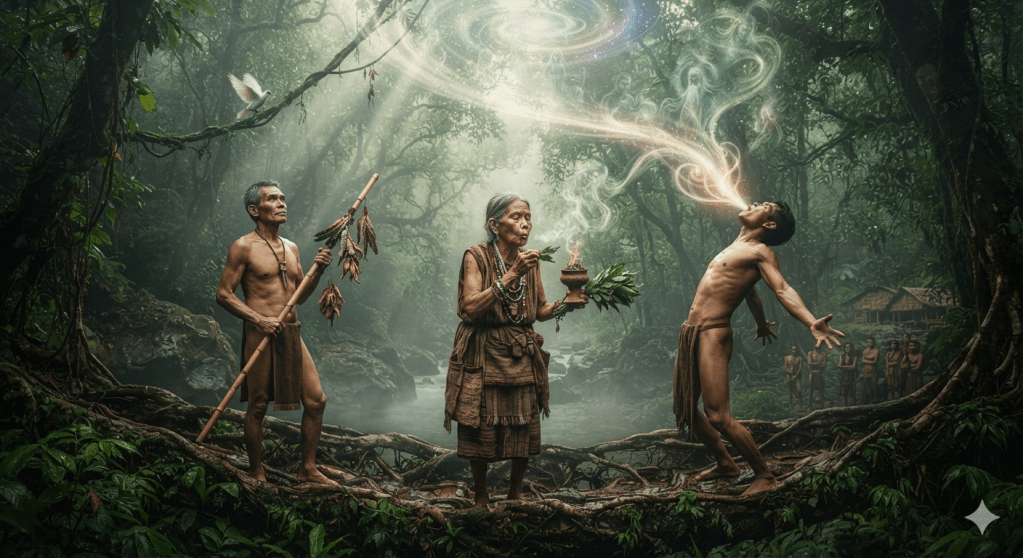
Deep within the ancient, mist-covered canopies of the Sierra Madre mountains, life moves to a rhythm completely independent of modern urbanization. For the Agta (or Aeta) people—one of the oldest indigenous groups in the Philippines—the forest is not just a collection of trees and resources. It is a living, breathing network of spiritual entities governed by ancient deities like Pawi, the god of the forest, all existing under the ultimate supremacy of the creator manifestation, Gutugutumakkan.
To navigate this highly charged spiritual ecosystem, the Agta rely on an incredibly unique group of individuals. While mainstream Philippine history often categorizes pre-colonial spiritual leaders under the broad Visayan term babaylan, the Agta maintain their own highly specialized, egalitarian system of spiritual guides: the Puyang, the Huhak, and the Anitu.
Here is an intimate look into how these spiritual specialists work, how they heal, and why their roles remain the lifeblood of the Agta community.
Moving Beyond the “Babaylan”: The Three Faces of Agta Shamanism
Unlike the lowland pre-colonial societies where shamans formed a highly institutionalized, high-status class aligned with political chiefs (Datus), Agta society is strictly egalitarian. They have no formal chiefs, rigid hierarchies, or schools for the priesthood.
Instead, spiritual leadership is dynamic and fluid. Depending on a person’s specific gift, they are recognized by three distinct native terms:
1. The Puyang (The Healer and Medium)
A puyang (sharing deep linguistic roots with the Malay pawang) is the community’s primary bridge to the spirit world. When a member of the camp falls ill, it is rarely seen as a purely physical ailment. It is almost always diagnosed as a spiritual conflict. The puyang’s job is to step directly into the spiritual crossfire, negotiate with the offending entities, and restore physical and communal harmony.
2. The Huhak (The Diviner and Seer)
While a puyang actively cures, a huhak focuses on foresight, perception, and divination. Living a semi-nomadic, hunter-gatherer lifestyle requires a deep understanding of what lies ahead. A huhak is tasked with reading the intricate “language of the forest”—interpreting omens, predicting weather shifts, tracking animal migrations, and identifying safety hazards before the camp packs up to move.
3. The Anitu / Mang-aanito (The Vessel)
The word anitu pulls double duty in Agta culture. It refers to the ancestral and environmental spirits themselves, but it also describes the person who serves as a direct flesh-and-blood vessel for them. A mang-aanito is a shaman who enters a deep, ecstatic trance state to let a spirit possess their body and speak directly to the living.
       [ THE SPIRIT WORLD ] (Pawi & the Anito)
                 ^
                 |  (Direct Communication)
                 v
       [ AGTA SPIRITUAL LEADERS ]
       /         |          \
 [ Puyang ]  [ Huhak ]  [ Anitu ]
 (Healer)    (Diviner)  (Vessel)
       \         |          /
                 v
        [ THE AGTA COMMUNITY ]
Fluid Boundaries
Are these three separate jobs? Yes and no. In a small, mobile hunting camp, keeping these roles segregated is highly impractical. A young Agta person might start out as an Anitu due to their natural sensitivity to spirit possession. As they age, gather ecological wisdom, and master herbal lore, they naturally step into the role of a Puyang. If they develop an exceptional knack for reading nature’s micro-movements, they are simultaneously consulted as a Huhak.
The Call: How an Agta Shaman is Chosen
You do not choose to become a shaman in Agta culture; you are chosen by the environment. The journey generally relies on three pillars:
- Hereditary Bloodlines (Linya): Spiritual gifts heavily flow through ancestral bloodlines. Sacred items like a healing knife (bolo) or distinct red cloth fragments are passed down across generations.
- The Spiritual Crisis (Sakit): A candidate’s initiation often begins with a sudden, severe, and unexplained illness that modern medicine cannot identify. During this time, the individual experiences vivid dreams or visions from the anito. The spirits offer an ultimatum: Serve as our mouthpiece to heal your people, or remain sick. Once the individual accepts the contract, their illness miraculously vanishes.
- Elder Mentorship: Experienced elders step in to guide the newly chosen shaman. They teach them how to navigate the spirit realm safely, recognize hundreds of forest plants, and sing the proper chants without offending the forest lords.
The Pag-aanito Trance vs. Lowland Rituals
The Agta trance ritual, known as pag-aanito or talibeng, is radically different from the structured, ceremonial rituals found in historical lowland Tagalog or Visayan traditions:
- Kinetic and Ecstatic: Lowland babaylans historically induced trances through static chanting, sacred wine, or sitting under blankets. Agta shamans enter trances through rapid, highly physical, repetitive dancing (talibeng) that mimics the movements of forest animals or bees.
- Minimalist Offerings: Lowland rituals frequently demanded grand blood sacrifices, like slaughtering water buffaloes or pigs. The Agta operate on a philosophy of “borrowing” rather than ownership. Their offerings to Pawi and the spirits are deeply symbolic and minimalist: bits of wild honey, rice, a pinch of tobacco, or strips of red cloth.
- Direct Negotiation: Instead of worshipping a distant deity through rigid priestly intercession, an Agta shaman treats the anito like a temperamental neighbor. During a trance, the shaman will actively argue, plead, or strike a face-to-face bargain with the spirit to save a patient’s life.
Reading the Forest: Environmental Omens of the Huhak
To a huhak, the forest is an open book. They do not rely on tools for divination; they rely on flawless ecological awareness. Three distinct omens they look for include:
- The Call of the Alimokon (White-eared Brown Dove): If this sacred bird coos from behind or to the left of a hunting party, it is a strict warning of danger (like a snake bite or injury), prompting the huhak to halt the expedition. If it calls from the right or front, the path is blessed with safety and abundance.
- The Movement of Lawa (Spiders): If thick cobwebs suddenly block a standard trail or spiders are seen moving downward, the huhak reads this as the anito closing that sector of the forest to conserve resources. Ignoring this and foraging anyway results in sudden illness.
- The Sun-Shower: Rain falling under a clear, bright sun indicates that Pawi or local spirits are actively walking the trails because a human has violated a taboo. The community is immediately told to lay low and offer peace tokens.
Enforcing the “Bawal” and the Puyang’s Pharmacy
Sickness in an Agta camp is almost always a sign of a broken ecological boundary—a violated bawal (taboo).
Strict Forest Taboos
- Failure to Ask Permission (Pasintabi): Entering deep forest zones or cutting down massive hardwood trees without verbally asking the spirits for permission is a direct insult to Pawi.
- The Mockery of Animals (Laway): Teasing, laughing at, or mocking any forest creature—even a trapped animal—is strictly forbidden. It is believed to trigger immediate environmental retaliation like lightning strikes or flash floods.
- Wasting Harvests: Over-hunting or ruthlessly harvesting wild honey without leaving a portion behind for the ecosystem heavily angers the forest lords.
The Material and Spiritual Cure
To cure the resulting illness, a puyang combines physical herbal science with spiritual intervention:
- Cleansing the Air: The ritual always begins by burning Kamanyan (fossilized tree resin) or Banawog (dark wood resin). The thick, fragrant smoke drives out malevolent invisible entities.
- Administering the Herbs: The puyang uses a rich botanical library, boiling Labtang vines into a bitter tea for severe stomach and internal infections, or crushing Alagaw leaves into a poultice for chest coughs and fevers. Wild ginger (Uya) is chewed and its infused saliva (tutho) is blown onto aching joints to drive out “cold” spirits.
- The Chants: An herb is never expected to work by chemistry alone. While applying the remedy, the puyang sings rapid, trance-like prayers (orasyon) in a non-standard dialect meant only for the spirits. The chant formally apologizes for the broken taboo and begs Pawi to “activate” the healing properties of the plant.
The Crucial Importance of Shamans in the Agta Community
In modern times, it can be easy to misinterpret traditional shamans as mere figures of folklore. However, to the Agta people, the puyang, huhak, and anitu are absolutely foundational to their ongoing cultural survival.
- They are Ecological Regulators: By enforcing the bawal through spiritual authority, these leaders effectively prevent over-hunting, deforestation, and resource depletion. They are, in a very literal sense, the original environmental conservationists of the Philippines.
- They are the Keepers of Living History: Because the Agta rely on oral traditions, shamans serve as living archives. Their chants, plant lores, and ritual songs preserve centuries of history, ancestral lineages, and deep ecological data that would otherwise be lost to time.
- They Keep the Peace: In a highly communal society without police or formal courts, spiritual leaders resolve social anxieties. When an illness or bad luck strikes a camp, the shaman provides a clear diagnosis, a path to forgiveness, and a concrete remedy, restoring psychological peace and unity to the group.
The next time we look at the vast, green ridges of the Sierra Madre, we must remember that it remains alive and thriving largely because of the Agta people and the quiet, fierce devotion of their spiritual guardians. They remind us of a profound truth we often forget: humans do not own the earth—we are merely borrowing it.


Leave a Reply