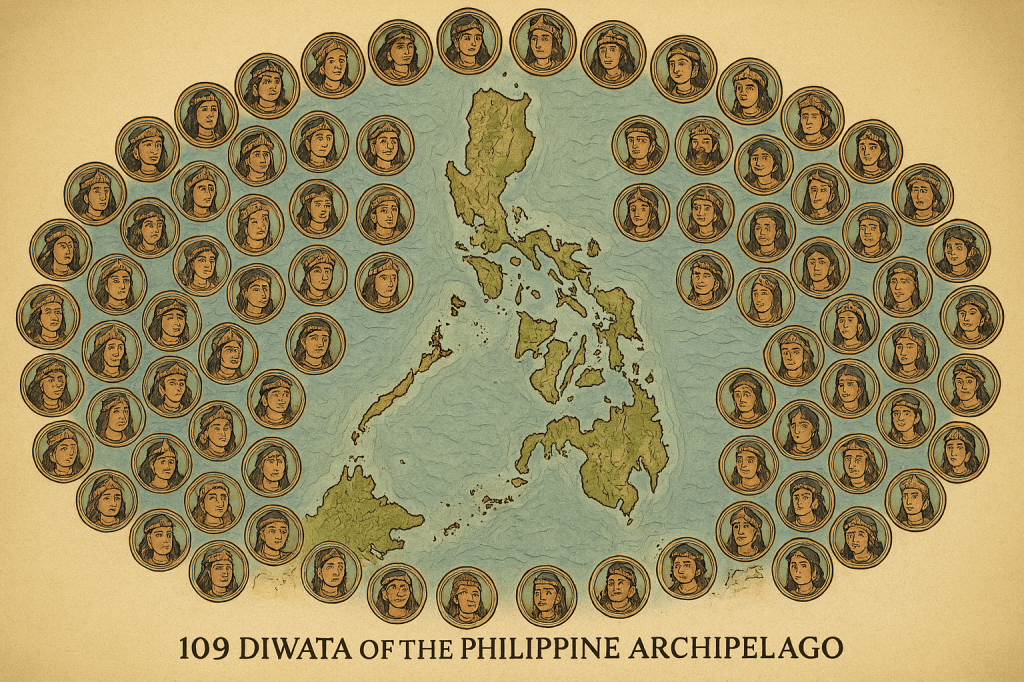
In the sacred work of restoring and honoring Indigenous Filipino Spirituality, Templong Anituhan affirms its mission to recognize the divine presence across the many cultures of the Philippine archipelago.
Through its unified liturgy and theological framework, the Temple has formally enshrined One Hundred Nine (109) distinct deity names, drawn from the living and ancestral traditions of 76 indigenous ethnolinguistic communities across Luzon, Visayas, Mindanao, and the island frontiers.
This enshrinement is not an act of unification through erasure, but a celebration of diversity held within sacred harmony—where each name is invoked with respect to its cultural origin, and each spirit is honored as part of a greater divine council:
Ang Kataas-taasang Konseho ng mga Diwata ng Kapuluan
(The Supreme Council of the Deities of the Archipelago)
The 109 Enshrined Deities and Their Peoples
(Condensed presentation for readability — full list maintained for clergy reference)
The 109 deities span the entire archipelago:
- Batanes & Northern Realms: Mapaytau, Mayo, Apo Iraya
- Cordillera & Highlands: Kabunian, Lumawig, Maknongan, Adika‑ila, Mengos‑ochong
- Cagayan Valley & Plains: Makapangwa, Namaratu, Nanolay
- Forest & River Peoples: Binangonan, Elag, Delan, Pandak, Oden
- Ilocos & Central Luzon: Buni, Angalo, Parsua, Malyari, Bathala
- Bicol: Gugurang
- Mindoro Mangyan: Ahulutok, Ambuwaw, Manggat, Sayum‑ay, Mahal na Makaako
- Palawan: Ampu Nagsalad, Maguimba, Magindusa
- Visayas: Kaptan, Magwayen, Kanlaon, Tungkong Langit, Alunsina, Gamhanan
- Mindanao Lumad: Magbabaya, Manama Sigalugan, Kerenen
- Bangsamoro & Maritime: Tuhan, Umboh Tuhan, Umboh Dilaut
These names represent Creators, Culture Heroes, Nature Spirits, and Ancestral Guardians, forming a complete spiritual ecosystem rooted in land, sea, sky, and memory.
From Enumeration to Living Theology
The significance of the 109 Sacred Names is not merely numerical.
Within Templong Anituhan, they are organized into a functional sacred hierarchy to guide clergy in ritual, teaching, and spiritual governance.
🕯️ THE SUPREME COUNCIL HIERARCHY (For Clergy Use)
🌕 I. The Primordial Source Council (KATAASTAASAN)
Role: Unity of all divine manifestations
Includes: Bathala • Kabunian • Maknongan • Magbabaya • Tuhan • Melu •
Kaptan • Tungkong Langit • Ampu Nagsalad • Mahal na Makaako • Ai Sono • Apo Dios
👉 Used for opening invocations and universal alignment
🌞 II. The Creator Architects Council
Role: Shapers of cosmos and humanity
Includes: Pamulak Manobo • Makapangwa • Nanolay • Malyari • Gugurang •
Amagaolay • Kerenen • Tagbusan • Taganlang • Laon
👉 Used in consecration and creation rites
🌄 III. Culture Heroes & Law-Givers
Role: Teachers of order, knowledge, and tradition
Includes: Lumawig • Angalo • Maka‑andog • Tagnaan • Mangetchay • Dadanhayan ha Sugay
👉 Used in initiation, teaching, and community rites
🌿 IV. Nature Sovereigns Council
Role: Guardians of elements and ecology
Domains:
- Forest: Diwata ng Kagubatan, Pawi
- Waters: Magwayen, Neguno, Umboh Dilaut
- Fire: Kanlaon, Gugurang
- Sky: Bulalakaw
👉 Used in healing and environmental rituals
🌙 V. Celestial Order Council
Role: Regulators of time and cosmic cycles
Includes: Kadaw La Sambad • Bulan La Mogoaw • Elag • Delan • Apo Init • Pandak
👉 Used in lunar, solar, and calendar rites
⚖️ VI. Order, Justice & Destiny Council
Role: Balance, protection, and moral order
Includes: Agtayabun • Makalindog • Dagaw • Tulus • Sualla • Meketefu • Minaden
👉 Used in protection, oath-taking, and conflict resolution
🌾 VII. Ancestral & First People Council
Role: Lineage, remembrance, identity
Includes: Manggat • Sayum‑ay • Apo Parawan • Dayang Dayang Mangolay • Binayo • Binayi
👉 Used in naming rites and ancestral invocation
🛡️ VIII. Guardians & Territorial Spirits
Role: Protection of land and community
Includes: Anlabban • Bago • Sirinan • Tigbalog • Kedes • Akasi • Dumagan
👉 Used in boundary protection and cleansing
🌊 IX. Maritime & Liminal Council
Role: Journeys, transitions, crossings
Includes: Mayo • Mapaytau • Magwayen • Umboh Tuhan • Umboh Dilaut
👉 Used in travel, transitions, and spirit guidance
🔥 X. Regional Councils (Operational Structure)
For practical clergy use, all deities are also grouped into:
- Luzon Council
- Visayas Council
- Mindoro–Palawan Council
- Mindanao Council
👉 Allows localized ritual adaptation
🕯️ Standard Ritual Sequence (Clergy Guide)
- Primordial Source – Opening
- Creator Council – Consecration
- Nature Sovereigns – Alignment
- Celestial Council – Timing
- Justice Council – Protection
- Ancestral Council – Connection
- Guardians – Sealing
- Return to Source – Closing
🌺 A Living Spiritual Map
Through this structure, Templong Anituhan affirms:
- Unity without erasure
- Diversity with dignity
- Ritual with purpose and order
The 109 Sacred Names are not just remembered—they are activated,
guiding clergy in their sacred role as Binabaylan of the New Yet Ancient Path.
✨ Closing Reflection
This enshrinement is a declaration:
That the Spirit of the Kapuluan lives.
That every mountain, river, and sea remembers.
And that the names of the Diwata shall continue to be spoken—
not in fragments, but in sacred unity.


Leave a Reply