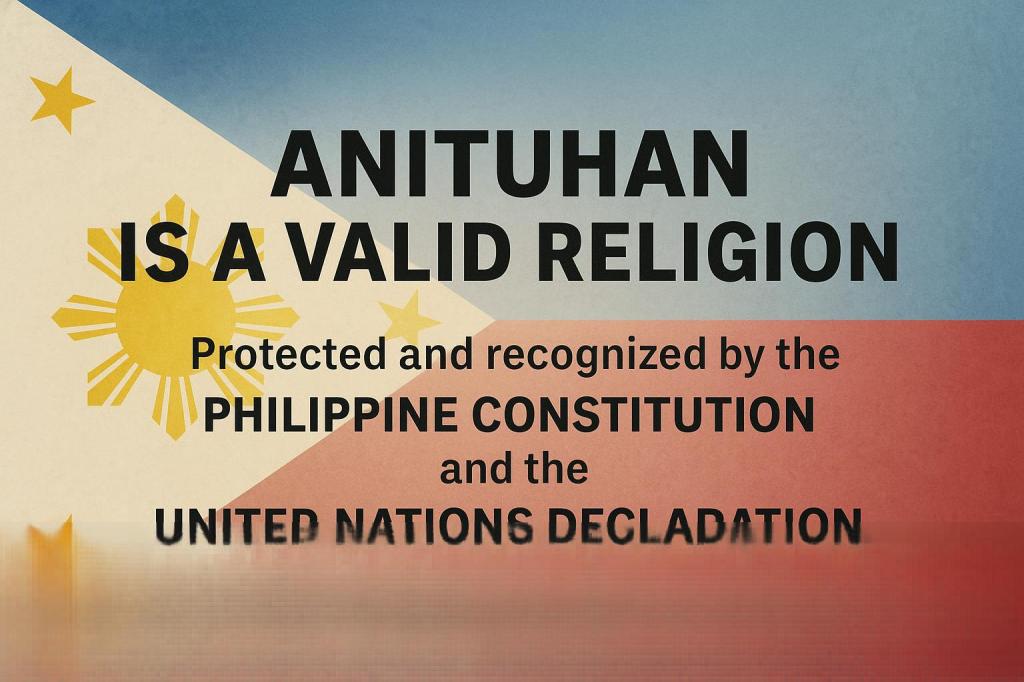
In an age where digital governance is rapidly expanding, the promise of inclusion must go hand in hand with technological progress. Government platforms such as the eGovPH mobile application aim to simplify public services and unify citizen data. However, a critical issue arises when these systems fail to reflect the full diversity of Filipino identity—particularly in the recognition of religion.
As a practitioner of Anituhan, an expression of Indigenous Filipino Spirituality, I encountered a significant limitation while completing my profile in the eGovPH app. The dropdown list for religion did not include my faith. Faced with this omission, I was left with only two options: either misrepresent myself by selecting another religion or leave my profile incomplete.
This is not merely a technical issue—it is a matter of constitutional rights, identity, and dignity.
The Right to Religious Freedom and Identity
The 1987 Philippine Constitution, under Article III (Bill of Rights), Section 5, clearly states:
“No law shall be made respecting an establishment of religion, or prohibiting the free exercise thereof.”
This provision guarantees every Filipino the right to profess, practice, and express their religion freely, without coercion, discrimination, or misrepresentation.
When government systems limit religious identification to a fixed list that excludes certain faiths, they unintentionally restrict the accurate expression of belief. This undermines the spirit of religious freedom by forcing individuals into categories that do not reflect their identity.
Indigenous Spirituality and Cultural Rights
The Philippines also recognizes Indigenous cultural and spiritual practices through the Indigenous Peoples’ Rights Act (IPRA) of 1997 (Republic Act No. 8371). This law affirms the rights of Indigenous peoples to:
- Practice and revitalize their spiritual traditions and customs
- Maintain and protect their cultural identity
- Be recognized and respected within national policies and systems
Anituhan, rooted in the reverence of Anito, Diwata, and ancestral spirits, is part of the broader continuum of Indigenous Filipino belief systems. As such, it deserves equal recognition alongside more commonly listed religions.
The Problem with Limited Dropdown Options
Government forms—whether digital or paper—serve as official records of identity. When religion is asked but not properly accommodated, it leads to:
- Misrepresentation of citizens’ beliefs
- Erasure of minority and Indigenous religions
- Data inaccuracy in national records
- Violation of personal dignity and self-identification
In some instances, public officers may fill in a person’s religion without transparency, further compounding the issue. This raises concerns about consent, accuracy, and respect.
A Call for Inclusive and Rights-Based Design
In light of these concerns, there is an urgent need for government agencies, especially those managing digital platforms like eGovPH, to adopt inclusive design principles. Specifically:
1. Expand Religion Options
Include Anituhan and other Indigenous belief systems in official dropdown menus.
2. Provide an “Others (Specify)” Field
Allow citizens to freely input their religion if it is not listed.
3. Ensure Transparency in Data Entry
Public officers should clearly confirm entries with citizens, especially in official transactions such as immigration.
4. Review Policies Across Agencies
Ensure that all public forms and databases reflect equal respect for all religions, not just the majority.
Toward a Truly Inclusive Nation
The Philippines is a nation rich in spiritual diversity—from mainstream religions to Indigenous traditions that predate colonial history. True inclusivity means making space for all, not only in principle but in practice.
Recognizing Anituhan in government forms is not simply about adding a word to a list. It is about affirming that every Filipino has the right to be seen, named, and respected according to their truth.
In honoring this right, we move closer to a government that truly reflects the people it serves.
Rev. Rolando Gomez Comon
Chief Priest, Practitioner of Anituhan
San Jose Del Monte City, Bulacan
On the Inclusion and Recognition of “Anituhan” in Government Forms and Digital Platforms
Prepared by:
Rev. Rolando Gomez Comon
Chief Priest, Practitioner of Anituhan
San Jose Del Monte City, Bulacan
Date: May 2026
I. Introduction
This Position Paper is respectfully submitted to call the attention of government agencies, particularly those responsible for public data collection systems such as the eGovPH platform, to a significant issue affecting religious freedom and identity representation: the absence of “Anituhan” as a recognized option in religion fields within government forms and digital systems.
This omission results in the misrepresentation and exclusion of individuals who practice Anituhan, an Indigenous Filipino spiritual tradition. It is imperative that government systems reflect the diversity of beliefs among Filipinos and uphold constitutional and international protections on freedom of religion.
II. Statement of the Problem
Current government forms and digital platforms, including the eGovPH mobile application, provide a limited list of religions in dropdown menus. The absence of Anituhan in these options creates the following issues:
- Denial of Accurate Self-Identification
Individuals are forced to select a religion that does not reflect their beliefs or leave the field incomplete. - Data Inaccuracy
Government records become unreliable when citizens are misrepresented. - Cultural and Religious Erasure
Indigenous Filipino spiritual traditions are marginalized or rendered invisible. - Risk of Unauthorized Classification
In some official processes, such as immigration, there is concern that personnel may assign a religion without transparency or consent.
III. Legal and Constitutional Framework
1. The 1987 Philippine Constitution
Under Article III, Section 5 (Bill of Rights):
“No law shall be made respecting an establishment of religion, or prohibiting the free exercise thereof.”
This provision guarantees:
- Freedom to profess and practice religion
- Freedom from coercion or forced identification
- Protection of religious identity and expression
Excluding a religion from official forms effectively limits the free exercise and declaration of belief, especially when such declaration is required in public systems.
2. Indigenous Peoples’ Rights Act (IPRA) of 1997 (RA 8371)
The IPRA law affirms:
- The right of Indigenous Peoples to preserve and develop their culture, spirituality, and traditions
- The obligation of the State to recognize and promote these rights
Anituhan, grounded in Indigenous Filipino cosmology and reverence for Anito, Diwata, and ancestral spirits, falls within the protected sphere of Indigenous spiritual practices.
3. United Nations Universal Declaration of Human Rights (UDHR)
Under Article 18:
“Everyone has the right to freedom of thought, conscience and religion; this right includes freedom to manifest his religion or belief…”
This includes:
- The right to identify with one’s religion
- The right to be recognized without discrimination
Failure to include Anituhan in official systems may constitute a barrier to the full enjoyment of this right.
IV. Policy Gaps and Systemic Concerns
Despite strong legal foundations, implementation gaps persist:
- Rigid data structures that do not accommodate minority or emerging religions
- Lack of “Others (specify)” fields in digital forms
- Absence of policy guidance requiring inclusivity in religious identification fields
- Insufficient training and awareness among public officers handling personal data
These gaps highlight the need for rights-based digital governance.
V. Position and Recommendations
In light of the foregoing, this Position Paper strongly asserts that:
Anituhan is a valid religion and must be recognized, respected, and accurately represented in all government systems.
The following actions are respectfully recommended:
1. Immediate Inclusion of “Anituhan”
All relevant government forms and digital platforms should include Anituhan in their list of recognized religions.
2. Implementation of “Others (Specify)” Option
Every religion field must include an open-text option to ensure inclusivity for all belief systems not yet listed.
3. Standardization Across Agencies
A unified policy must be issued requiring all government agencies to adopt inclusive and flexible religious identification fields.
4. Transparency in Data Collection
Public officers must:
- Ask and confirm religious identity clearly
- Avoid assigning values without the individual’s consent
5. Cultural Sensitivity and Training
Government personnel should undergo orientation on:
- Indigenous spirituality
- Religious diversity
- Human rights-based data handling
VI. Conclusion
The recognition of Anituhan in government systems is not merely an administrative adjustment—it is a moral, cultural, and legal obligation.
A truly inclusive Philippine society must ensure that every citizen can declare their identity without fear of erasure or misrepresentation. In doing so, the government reaffirms its commitment to:
- Religious freedom
- Cultural dignity
- Human rights for all
To include Anituhan in official documents is to affirm that Indigenous Filipino spirituality continues to live, belong, and be honored in the modern nation.
VII. Closing Statement
We respectfully call upon all relevant agencies to take immediate and concrete steps toward the recognition of Anituhan and other Indigenous belief systems in all public forms and data systems.
No Filipino should be invisible in their own country.


Leave a Reply