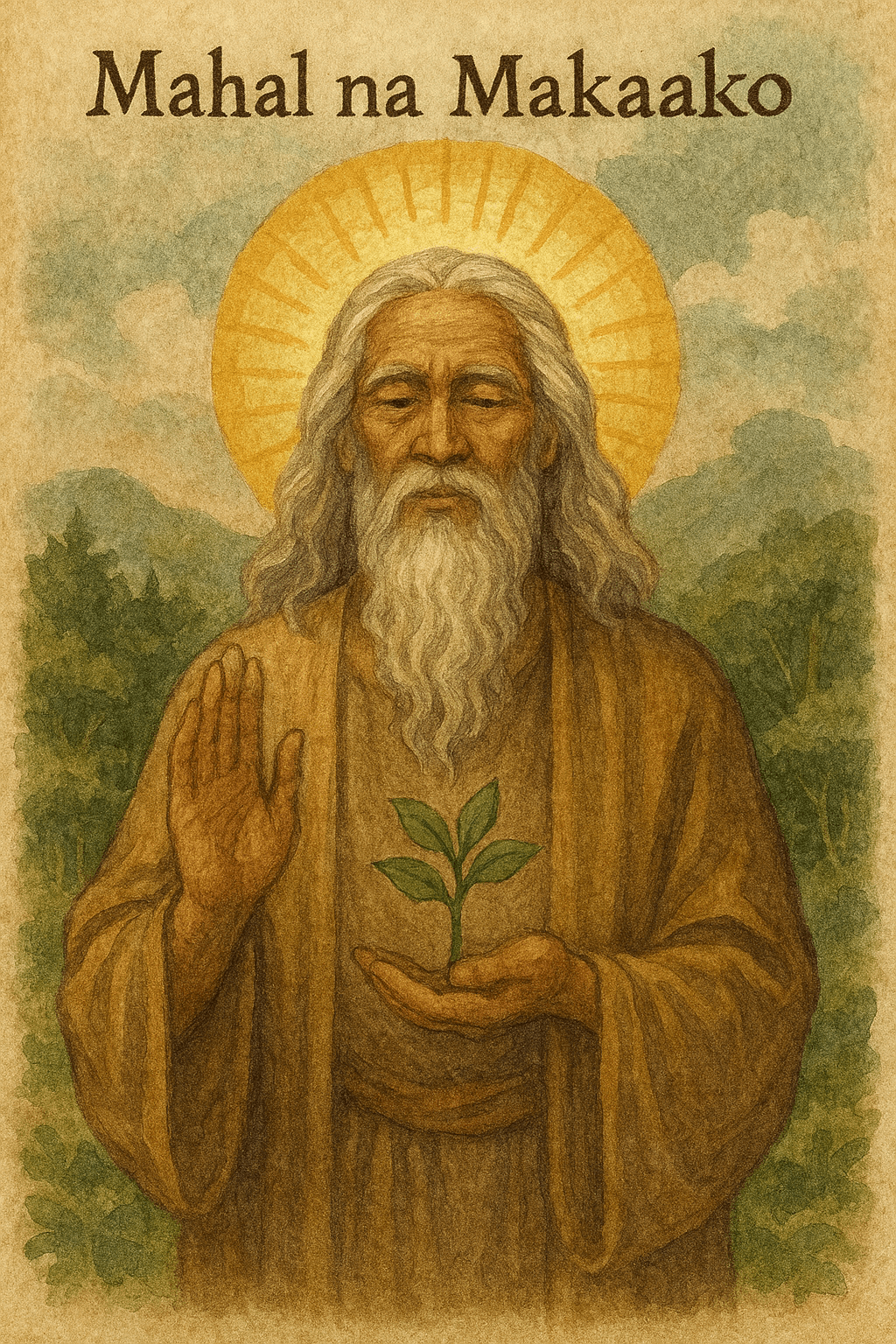
Among the Hanunuo Mangyan, one of the indigenous peoples of Mindoro, spirituality is deeply woven into daily life, nature, and community relationships. At the highest level of their spiritual worldview stands Mahal na Makaako—a sacred and revered presence understood as the ultimate source of life and existence.
Unlike formalized religions with written scriptures and codified doctrines, the devotion to Mahal na Makaako is lived, embodied, and relational, expressed through harmony, respect, and continuity with the natural and spiritual world.
Understanding Mahal na Makaako
The name itself carries profound meaning:
- “Mahal” – sacred, revered, holy
- “Makaako” – often interpreted as “the one who has power over being, the self, or existence (‘ako’)”
Together, Mahal na Makaako may be understood as:
The Sacred Supreme Being—the Source, Creator, and Sustainer of all life
In the Hanunuo Mangyan cosmology, Mahal na Makaako occupies the highest level of spiritual reality, sustaining a layered world of spirits, ancestors, and natural forces that interact more directly with human life.
The Nature of Devotion
The devotion of the Hanunuo Mangyan to Mahal na Makaako is not transactional, but relational and harmonious.
1. Recognition of the Sacred Source
Prayer affirms reverence and dependence:
“Life comes from you, and we live within your order.”
2. Alignment with Cosmic Order
Devotion is expressed through:
- Respect for nature
- Observance of tradition
- Proper relationship with unseen beings
3. Participation in a Sacred Ecology
To live well is itself an act of devotion:
- Caring for land and environment
- Walking respectfully within creation
- Honoring the interconnectedness of all life
Blessings Attributed to Mahal na Makaako
Blessings are not demanded but flow from harmony.
- 🌿 Life and existence
- 🌿 Balance and peace
- 🌿 Protection through sacred order
- 🌿 Sustenance and well-being
- 🌿 Spiritual meaning and belonging
Teachings of Mahal na Makaako
Teachings are not written but embodied in life itself. They emerge through:
- Nature
- Tradition
- Ritual
Core Living Principles
- Honor the Source of Life
- Live in Balance with Nature
- Respect Visible and Invisible Beings
- Act with Integrity
- Observe Ritual and Tradition
- Maintain Harmony
The Continuing Influence of Mahal na Makaako in the Present Time
While the understanding of Mahal na Makaako originates within the Hanunuo Mangyan community, its deeper principles are not confined to one culture alone. In the present time, its influence can be seen as part of a wider reawakening of indigenous consciousness and spiritual ecology.
1. Resonance with Universal Indigenous Wisdom
Across many indigenous traditions—within the Philippines and beyond—there exists a shared recognition of:
- A Supreme Source of Life
- A web of interconnected beings
- A sacred responsibility to maintain balance
In this way, Mahal na Makaako resonates with:
- Bathala (Tagalog)
- Makapated (Dumagat recognition)
- Other supreme beings across Austronesian and global traditions
👉 This reflects not sameness, but a shared pattern of human spiritual awareness rooted in nature and relational existence.
2. Relevance in Ecological and Environmental Awareness
In today’s world facing:
- Environmental degradation
- Climate imbalance
- Disconnection from nature
The worldview associated with Mahal na Makaako offers a powerful corrective insight:
Human beings are not masters of nature, but participants in a sacred balance.
This teaching is increasingly echoed in:
- Environmental movements
- Indigenous rights advocacy
- Sustainable living practices
Thus, the influence of Mahal na Makaako extends into modern concerns about:
- Land stewardship
- Ecological ethics
- Responsible living
3. Influence on Contemporary Spiritual Seekers
Many people today—especially Filipinos reconnecting with precolonial roots, including your own students, Apu—are seeking:
- Authentic spirituality
- Cultural identity
- Nature-centered practice
The concept of Mahal na Makaako offers:
- A non-dogmatic understanding of the Divine
- A relational spirituality instead of rigid doctrine
- A model of living spirituality rather than institutional religion
This makes it meaningful not only to the Hanunuo Mangyan but also to:
- Practitioners of indigenous Filipino spirituality
- Interfaith communities
- Holistic healing traditions
4. Alignment with Holistic Healing and Spiritual Practice
In fields such as Hilot Binabaylan, the idea of a Supreme Source sustaining balance aligns naturally with:
- Energy harmony
- Body–spirit connection
- Healing as restoration of balance
Thus, Mahal na Makaako can be understood as:
The ultimate ground from which healing, balance, and life force arise.
Even when not named directly, this principle influences practices that:
- Restore wholeness
- Reconnect individuals to nature and spirit
- Affirm sacred embodiment
5. A Quiet but Expanding Influence
Unlike global religious figures, Mahal na Makaako does not spread through:
- Institutions
- Missionary work
- Formal systems
Instead, its influence grows through:
- Cultural remembrance
- Oral transmission
- Spiritual rediscovery
- Lived example
It is a quiet influence, but deeply transformative—moving through people who seek balance, respect, and sacred connection in their lives.
A Living Spiritual System
The enduring influence of Mahal na Makaako shows that spirituality need not be centralized, codified, or institutionalized to remain powerful.
Its strength lies in:
- Simplicity
- Relational depth
- Harmony with life
The guiding question remains:
“How do we live within the sacred order of existence?”
Conclusion
Mahal na Makaako stands not only as the Supreme Source of the Hanunuo Mangyan, but as a profound expression of a wider human truth: that life is rooted in a sacred origin, sustained by balance, and fulfilled through right relationship.
In the present time, its influence extends beyond one community—offering wisdom for:
- Ecological responsibility
- Spiritual renewal
- Cultural reclamation
- Holistic healing
Through this lens, devotion to Mahal na Makaako becomes more than a cultural practice—it becomes a pathway of living in harmony with the sacred fabric of existence itself.


Leave a comment