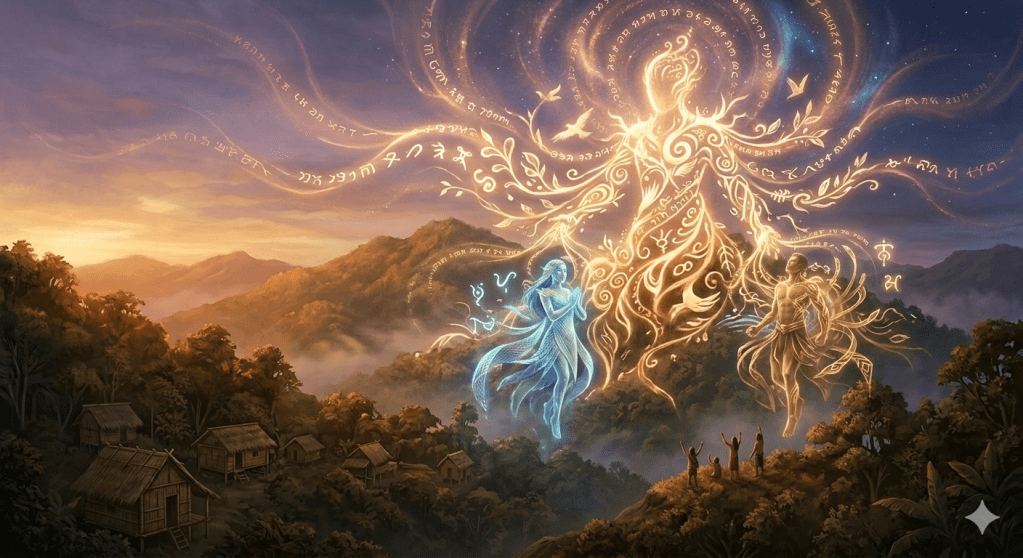
The Primordial State
In the high, cloud‑covered mountains of Mindoro, within the ancestral forests of the Buhid Mangyan, it is taught that before all forms, before sound, movement, or division of the world, there existed only Mahal na Makaako—the Supreme Spirit and First Cause of all existence.
Mahal na Makaako is not understood as a craftsman who molds matter, nor as a force that struggles against resistance. Rather, he is Pure Being and Pure Awareness. His creative power does not arise from labor, but from intentional vision. In Buhid understanding, reality comes into form through divine recognition.
The Divine Gaze as Creative Act
At the beginning of time, Mahal na Makaako directed his Divine Gaze toward the still and empty highlands. This gaze was not mere sight but a conscious act of presence—an emanation of divine awareness into the void.
Where the gaze rested, the air itself grew dense with meaning. From this saturation of divine attention, two beings manifested fully and immediately. They were not shaped from soil, wood, or bamboo. They did not emerge from existing matter. They came into being through seeing.
These beings were Manggat and Sayum‑ay, the First Father and First Mother of the Buhid Mangyan people.
The Nature of the First Ancestors
Because Manggat and Sayum‑ay were created through the Divine Gaze of Mahal na Makaako, their nature was distinct from that of later humans.
They were human in form yet spiritual in essence. Their bodies were vessels of living divine energy. Their bones functioned as channels through which sacred vibration flowed. Their blood carried the warmth of first light, and their breath aligned them with both the physical mountains and the invisible spirit world.
They could walk the forest paths while simultaneously perceiving the Anitos and other unseen beings that dwell within trees, stones, and flowing water. In them, the material and spiritual realms were not separate.
The Naming of the World
Upon becoming fully aware, Manggat and Sayum‑ay inherited a task encoded into their being: the Ordering of Creation through Naming.
Guided by the divine clarity within them, they traveled across the land. They addressed the mountains, forests, rivers, stones, spirits, and creatures, calling each by its true name. These names were not labels but acts of recognition that finalized the structure of the world.
Because their voices carried the resonance of Mahal na Makaako’s original gaze, the land responded. Through Naming, chaos became relationship, and the world entered into harmonious order.
The Sacred Covenant with the Land
After the Naming of the World, the mountains of Mindoro stood as a prepared dwelling, awaiting a people rooted in responsibility rather than domination. Manggat and Sayum‑ay recognized that their lineage must live not as owners of the land, but as its guardians and mirrors.
They entered into a sacred covenant that would define Buhid identity for all generations.
Manggat and the Establishment of Tultul (Law)
Manggat assumed the role of protector, elder, and lawgiver. Through wisdom granted by Mahal na Makaako, he articulated the Tultul—the oral laws, customs, and ethical principles of the Buhid Mangyan.
The Tultul teaches that:
- The land is sacred because it reflects divine presence.
- Humans must take only what is necessary for life.
- The spirits of place must be respected through proper conduct and ritual balance.
- Harmony, not accumulation, is the measure of wealth.
Through the Tultul, Manggat anchored divine order into daily life.
Sayum‑ay and the Birth of Culture
Sayum‑ay became the bearer of cultural and spiritual knowledge. It is said that she was the first to hear sacred patterns within the mountain winds and translate them into Buhid song and oral memory.
She taught:
- The healing properties of forest plants
- The weaving of fibers into suwat (clothing)
- The rhythms of work, rest, and ritual life
- The intimate relationship between body, land, and spirit
Through her, knowledge became nurture, and tradition became embodied practice.
The Sacred Script and Memory
Together, Manggat and Sayum‑ay inscribed the first symbols of the Buhid script upon bamboo. These characters were not merely tools of communication but vessels of remembrance.
Writing ensured that the names of the world, the laws of balance, and the sacred covenant with the land would endure beyond spoken memory. Through literacy, divine energy was transmitted through knowledge and lineage.
The First Community and Ancestral Domain
As families emerged, Manggat and Sayum‑ay instructed them in building balay—homes that rested lightly upon the earth. They defined ancestral boundaries not as walls of exclusion, but as zones of responsibility.
Thus was established the Buhid Ancestral Domain, a sacred landscape under the unseen yet constant awareness of Mahal na Makaako.
The Ginoo: Ever‑Present Ancestors
In time, Manggat and Sayum‑ay became known as the Ginoo—the Great Ancestors. Though no longer seen, their presence continues through law, song, script, healing, and ethical life.
Every Buhid Mangyan who walks the mountain paths, chants the ancient verses, or writes upon bamboo carries within them a spark of the original Divine Gaze.
They are not children of dust alone,
but descendants of light, vision, and sacred responsibility.
The Doctrine of the Divine Vessel
The Sacred Materiality of Sayum‑ay and Manggat
In Buhid Mangyan sacred understanding, the manner by which Sayum‑ay and Manggat were created is as significant as their purpose. Mahal na Makaako did not merely animate existing matter; nor did he impose spirit upon lifeless flesh. Instead, the Supreme Spirit generated their very substance as a deliberate vessel for divine presence.
Their bodies were intentionally formed as Divine Vessels—material existences designed to hold, transmit, and sustain sacred energy within the physical world.
Flesh as Consecrated Substance
The flesh of Sayum‑ay and Manggat was not ordinary flesh. It was not subject to corruption, excess, or separation from spirit. Their skin, muscles, sinews, and bones were consecrated material, brought into being already aligned with divine order.
In this teaching, the body is not a prison of the spirit, nor a temporary shell. It is a sacred architecture, purpose‑built to anchor divine awareness into lived existence.
Because Mahal na Makaako formed them through vision rather than labor, their material bodies were perfectly attuned—each element resonating with cosmic balance. Their bones functioned as sacred channels, capable of holding vibration and transmitting wisdom. Their blood carried both biological life and spiritual memory. Their breath united mountain air with sacred intention.
Thus, the body itself became scripture.
The Body as Bridge Between Worlds
Sayum‑ay and Manggat were created to stand between realms. Their physical bodies were not obstacles to spirituality; they were the means by which the unseen could interact with the seen.
Through their bodies:
- The spirits of the land could be perceived and addressed
- The rhythms of the earth could be felt and interpreted
- Sacred law could be embodied, not merely spoken
Their senses were refined instruments. Their sight perceived both form and essence. Their hearing detected not only sound but meaning. Their touch recognized the living presence within stone, bark, and flowing water.
This establishes a core Buhid doctrine: true spirituality is embodied.
The Transmission of Divine Energy Through Lineage
Because Sayum‑ay and Manggat were fashioned as Divine Vessels, their descendants did not inherit only bloodlines or genetic traits. They inherited a measured continuation of divine capacity.
Although later humans would experience greater separation between body and spirit, the Buhid maintain that every descendant still carries a residual spark of the original Divine Gaze—embedded within the body itself.
This is why:
- Healing is performed through touch
- Knowledge is transmitted through practice, not abstraction
- Ritual posture, breath, and movement are sacred acts
The body remembers what the spirit alone cannot sustain.
Ethical Consequences of the Divine Vessel Doctrine
From this understanding arises a foundational ethical principle of the Buhid Mangyan: to harm the body without necessity is to disrespect divine intention.
The teachings emphasize:
- Care for the body through moderation and balance
- Respect for bodily rhythms aligned with nature
- Rejection of excess that weakens harmony
- Recognition that illness reflects imbalance, not punishment
Healing traditions exist not to dominate the body, but to restore it to its role as a sacred vessel.
The Living Template of Humanity
Sayum‑ay and Manggat are remembered not only as ancestors, but as the original template of human wholeness—beings in whom body, spirit, law, culture, and land were fully integrated.
Their creation affirms a central doctrinal truth:
Humanity was not meant to escape the body to reach the sacred.
Humanity was created so that the sacred could dwell within the body.
To this day, every Buhid Mangyan who walks upright, speaks truth, offers healing, or lives lightly upon the land continues the original function of Sayum‑ay and Manggat: to be a living vessel of divine presence in the world.
The Continuing Teachings of Anitong Sayum‑ay and Manggat
Naming as Awareness, Recognition, and Self‑Reflection
The sacred work of Sayum‑ay and Manggat did not end with the Naming of the World. In Buhid Mangyan doctrine, their act of naming is understood not merely as a primordial event but as an ongoing spiritual discipline transmitted through lineage, memory, and practice.
To name is not only to identify creation—it is to recognize what is truly present.
Naming as Conscious Recognition
Anitong Sayum‑ay and Manggat teach that the same clarity used to name trees, mountains, spirits, and waters must also be applied to the movements of life itself. Just as they recognized the true essence of each being in the natural world, they teach their descendants to recognize the true nature of situations unfolding around them.
This teaching instructs the practitioner to ask:
- What is truly happening, beyond appearances?
- What energies, intentions, or imbalances are present in this moment?
- What within me is responding, and why?
In this sense, naming becomes awareness—the ability to perceive reality without distortion, fear, or denial.
Situational Awareness as Sacred Practice
Through the guidance of Sayum‑ay and Manggat, recognition extends beyond objects and enters lived experience. Events, relationships, conflicts, and changes are also to be “named.”
To fail to name a situation is to remain unconscious within it.
To name it truthfully is to regain balance and agency.
Thus, their teaching cultivates:
- Discernment over reaction
- Presence over confusion
- Understanding over judgment
By recognizing a situation for what it is, one prevents harm, chooses wisely, and restores harmony.
Naming the Self: Reflection and Accountability
The doctrine further teaches that one must not only name the external world but also name the self.
Anitong Sayum‑ay and Manggat invite practitioners to engage in self‑reflection:
- To name one’s emotions without being consumed by them
- To recognize inner conflict before it manifests as harm
- To identify personal imbalance as an opportunity for healing
This practice affirms that awareness is not separation from experience, but conscious participation within it.
Naming as Healing and Alignment
In Buhid understanding, what is unnamed becomes chaotic. What is named can be addressed, healed, and re‑aligned.
This is why:
- Healing traditions begin with recognition of imbalance
- Conflicts are resolved through acknowledgment, not suppression
- Silence is used not for avoidance, but for clarity
The ability to name accurately restores the practitioner’s role as a Divine Vessel, capable of holding truth without distortion.
The Living Function of the Great Ancestors
Anitong Sayum‑ay and Manggat remain present not as distant figures of myth, but as active teachers of consciousness. Their lesson is lived each time a Buhid Mangyan—or any sincere practitioner—chooses awareness over impulse and reflection over chaos.
Their teaching can be summarized as follows:
To name is to see.
To see is to understand.
To understand is to act in harmony.
Through this living doctrine, Sayum‑ay and Manggat continue their original mission: ensuring that humanity does not wander blindly through creation, but walks with eyes open—aware of the land, the spirits, the moment, and the self.
Let us Pray
O Mahal na Makaako,
Supreme Spirit, First Awareness,
Source of life, light, and all that is seen and unseen—
We acknowledge You as the origin of all creation,
The One whose Divine Gaze called existence into being.
We give praise and thanks to You,
For through Your sacred vision
You brought forth Sayum‑ay and Manggat,
Our First Mother and First Father,
Fashioned not from dust alone
But as Divine Vessels of Your presence.
From Your gaze, You gifted us ancestors
Who could see clearly,
Who could name truthfully,
Who could walk the land in balance with spirits and breath.
Anitong Sayum‑ay, Anitong Manggat,
Great Ancestors and guides of our lineage,
We honor you today.
You who taught the naming of creation,
Teach us now to recognize what unfolds around us.
Help us see situations as they truly are,
Not as fear distorts them,
Not as pride conceals them,
But as they stand in truth.
Teach us to name our thoughts,
Our emotions,
Our actions and intentions—
So we may respond with wisdom instead of impulse,
With reflection instead of confusion.
May we remember that our bodies are sacred vessels,
Living echoes of your original form,
Carrying the spark of Mahal na Makaako within us.
Teach us to care for our bodies,
To listen to them,
And to walk gently upon the land entrusted to us.
O Mahal na Makaako,
We worship You with gratitude,
For You did not leave humanity without guides.
Through Sayum‑ay and Manggat,
You anchored us to the land,
To law, to song, to memory, and to awareness.
Today, as we walk,
May our steps be mindful.
As we speak,
May our words be true.
As we choose,
May our actions reflect harmony.
May the Divine Gaze that birthed our ancestors
Awaken again within us—
So we may live as people of balance,
As keepers of awareness,
As vessels of sacred presence.
We offer this prayer in honor, remembrance, and devotion.
May it rise with the breath of the mountains
And return as guidance for our path.
Makaako na Mahal, purihin Ka.
Sayum‑ay at Manggat, igalang at alalahanin namin kayo.
Mayari Na!


Leave a Reply