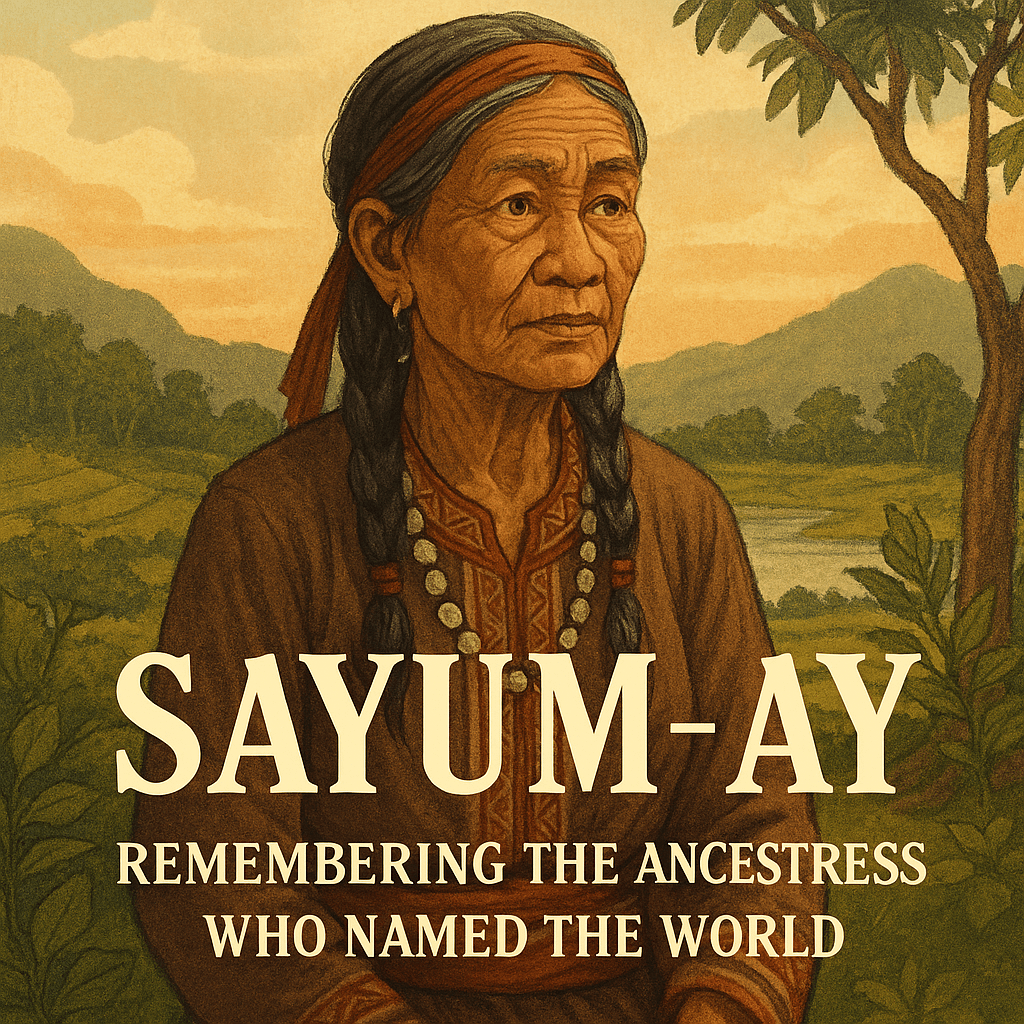
In many Indigenous cosmologies, the beginning of the world is not marked by conquest, but by relationship—between land and people, memory and name, ancestor and descendant. For the Buhid Mangyan of Mindoro, this remembering begins with Sayum‑ay and Manggat, the primordial ancestral couple believed to be the first inhabitants of their ancestral domain.
Through them, the world came into order—not by domination, but by naming. To name is to recognize, to acknowledge relationship, and to accept responsibility. This ancient ethic carries teachings that resonate deeply with Anituhan, a living spiritual practice grounded in memory, ancestral guidance, and right relationship.
Who Is Sayum‑ay?
Sayum‑ay is remembered in Buhid Mangyan tradition as the wife of Manggat and a primordial ancestress. Together, they are believed to have named all trees, animals, rivers, mountains, stones, and spirits within the Buhid ancestral lands. Naming is not symbolic alone—it is an act of ordering the world through recognition.
Because Sayum‑ay and Manggat came first, Buhid Mangyan identity, belonging, and legitimacy flow from them. The land is not simply occupied; it is known, remembered, and related to. To be Buhid is to belong to a world already named by ancestors.
Sayum‑ay as Ancestral Spirit (Anito)
Across many Philippine traditions, Anito refers to ancestral spirits who continue to walk with the living. While each Indigenous culture holds its own language and framing, Sayum‑ay and Manggat clearly function as ancestral beings whose presence continues through memory, land, and moral order.
In Anituhan, ancestors are approached not as distant gods, but as elders—those who have already walked the human path and whose lived wisdom remains accessible. In this sense, Sayum‑ay may be respectfully acknowledged as Anitong Sayum‑ay: an ancestral elder remembered for grounding the world in relationship rather than control.
The Sacred Act of Naming
One of Sayum‑ay’s most enduring teachings is the power of naming.
To name is:
– to see clearly,
– to claim responsibility,
– and to refuse erasure.
A tree without a name becomes lumber.
A river without a name becomes a resource.
A people without remembered ancestors become displaced—even on their own land.
Sayum‑ay reminds us that healing begins when what has been forgotten is named again with care.
Lessons Sayum‑ay Offers Anituhan Today
1. Guidance Comes from Memory
Ancestors guide not because they are powerful, but because they **remember**. In Anituhan, prayer to Anito is an act of listening—seeking clarity from those who walked before us.
2. Authority Is Relational
Sayum‑ay and Manggat do not rule by force. Their authority flows from relationship with land and life, offering a corrective to spiritual systems centered on domination.
3. Land Is Kin
What is named becomes family. Sayum‑ay’s story affirms Anituhan’s ethic that land is not property, but relative.
4. Women as Bearers of Cosmology
Sayum‑ay stands as co‑founder, co‑namer, and co‑ancestor. She reminds us that women have always held sacred memory and cosmological authority.
Praying to Sayum‑ay in an Anituhan Context
Within Anituhan, it is appropriate to pray to ancestral spirits for guidance, remembrance, and alignment, provided this is done:
– with humility,
– with acknowledgment of cultural origin,
– and with clear distinction from the Supreme Source and higher Diwata.
Such prayer is not ownership; it is relationship.
Anituhan Prayers and Reflection Prompts
The following are offered as devotional and pedagogical tools, suitable for personal practice, teaching spaces, or communal reflection within Anituhan.
Anituhan Prayer of Ancestral Listening
Anitong Sayum‑ay, Ina ng mga Ngalan,
Anitong Manggat, Ama ng mga Landas,
Kami’y humaharap nang may paggalang,
hindi upang mag‑utos, hindi upang umangkin,
kundi upang makinig at umalaala.
Ipaalala ninyo sa amin
ang tamang pangalan ng lupa,
ang wastong ugnayan sa kapwa,
at ang landas na nililihis ng aming alaala.
Turuan ninyo kaming lumakad
nang marahan, may dangal, at may pananagutan—
bilang mga anak ng lupa
at tagapagtuloy ng buhay.
Sa alaala, sa ugnayan, sa liwanag ng mga nauna.
🕯️ Short Invocation for Guidance
Mga Anito ng Unang Alaala,
ituloy ninyo sa amin ang aral ng tamang pakikipag‑ugnayan,
upang ang aming mga pasya ay magbigay‑buhay,
at ang aming mga yapak ay hindi makapanakit sa lupa.
Reflection Prompts for Practice and Teaching
On Naming
– What in my life remains unnamed—and therefore unattended?
– How does naming create responsibility rather than control?
On Ancestral Guidance
– When I seek guidance, whom am I truly listening to?
– How would my choices change if I treated ancestors as elders?
On Land and Relationship
– In what ways do I treat land as kin rather than resource?
– How do my daily actions honor where I stand?
On Memory
– What ancestral teachings were lost or silenced in my lineage?
– How can remembrance become an act of healing?
On Humility
– Does my spirituality deepen relationship or center my power?
– How does Sayum‑ay redefine authority for me?
Closing Reflection
To remember Sayum‑ay is not to claim her,
but to stand correctly:
with humility before the ancestors,
with care toward the land,
and with responsibility for the names we carry forward.
 Templong Anituhan
Leave a comment