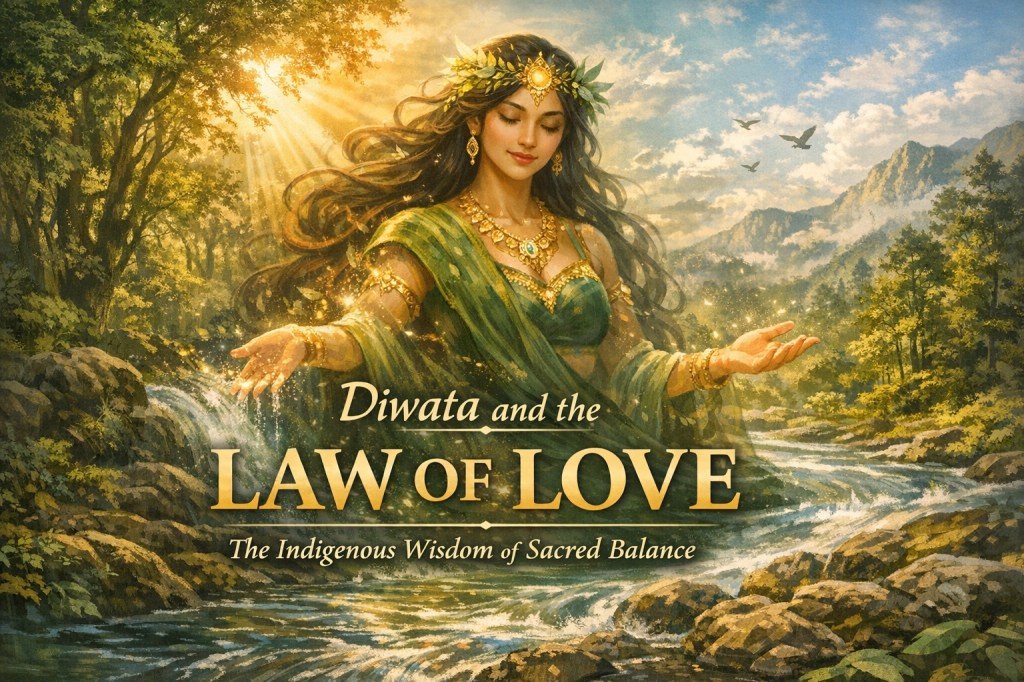
In many modern conversations about spirituality, love is often reduced to emotion, and the sacred is imagined as a super‑human being who feels anger, pleasure, or offense. Indigenous wisdom offers a very different, and much deeper, understanding—one that speaks not of emotion, but of law, balance, and right relationship.
At the heart of Indigenous Filipino spirituality is the presence of the Diwata. Too often misunderstood as mythical beings with human personalities, the Diwata are better understood as living expressions of sacred law—the intelligence that keeps life in harmony. This article reflects on a simple yet profound insight: The Diwata are law. > God is love. > And love, when understood rightly, is the law that sustains life.
Diwata Beyond Human Emotion
In Indigenous worldview, the Diwata are not human. They do not possess ego, emotional wounds, or psychological reactions. They do not become angry in the way humans do, nor do they feel affection as sentiment. Instead, the Diwata respond. Their response is not emotional, but relational. When harmony is maintained, their presence is experienced as blessing, flow, and abundance. When balance is disturbed, their response is felt as correction, resistance, or disruption. A raging river, for example, is often described as the “anger” of the river spirit. But in Indigenous understanding, the river is not angry. It is reasserting its law. Water must flow. Obstruction demands release. Balance requires restoration. What humans call “anger,” the Diwata express as truth in motion.
The Diwata as Living Law
To say that the Diwata are law does not mean written rules or moral commands. Indigenous law is not juridical; it is ecological, relational, and embodied. The Diwata govern:
– The flow of water
– The rhythm of seasons
– The fertility of land
– The continuity of life
– The proper relationship between humans and the natural world
This law is not imposed from above. It is woven into reality itself.
Fire burns.
Water flows.
Life seeks balance.
The Diwata are the conscious guardians of this order.
Love as Law, Not Emotion
This Indigenous understanding opens a powerful doorway to re‑examining the idea of love. In many traditions, including Christianity, we encounter the phrase: “God is love.” This statement is often misunderstood emotionally, as if love were merely affection or kindness. But at a deeper level, love is not a feeling. Love is the principle that sustains relationship and life.
In Indigenous terms, love is: – Right relationship (tamang ugnayan) – Reciprocity – Responsibility – Care for continuity – Balance across generations Love is expressed not by words, but by how one lives: – How one takes from the land – How one gives back – How one honors ancestors – How one considers the unborn This is love as law.
Reciprocity: The Core of Indigenous Love
One of the clearest expressions of the Law of Love in Indigenous cultures is reciprocity. You do not take without giving. You do not receive without gratitude. You do not heal without offering thanks. You do not harvest without care for renewal. Rituals, offerings, and prayers are not acts of appeasement. They are acts of relational maintenance—ways of keeping the sacred exchange intact. When reciprocity is broken, imbalance follows. The Diwata respond not to punish, but to restore the broken flow.
Love Includes Correction
Indigenous love is not sentimental. It does not avoid boundaries or consequences. A flood that clears polluted banks, A storm that breaks weakened structures, An elder who disciplines for the sake of wisdom— These are not expressions of cruelty. They are expressions of love that protects life. Love restores. It does not retaliate. Love corrects. It does not take revenge. This is why the Diwata are feared only by those who misunderstand them. To those who live in right relationship, the Diwata are allies, teachers, and guardians.
Law Written on the Land, Not on Paper
Indigenous law is not primarily written in texts. It is written in: – Rivers and mountains – Seasons and cycles – Bodies and breath – Memory and ritual To live in love is to listen—to the land, to elders, to the unseen, to the quiet corrections of life itself. This is why spirituality is embodied. How you walk, eat, heal, speak, and remember is already a spiritual act. Love that is not embodied is incomplete.
A Simple Indigenous Expression of the Law of Love
If distilled into a few lines, the Indigenous Law of Love may be expressed as:
> Care for what sustains you.
> Respect what you depend on.
> Restore what you disturb.
> Pass on what you receive.
This is not poetry alone. It is law.
Conclusion: Love as Sacred Order
When we say the Diwata are law, and love is law, we are not reducing the sacred—we are deepening our understanding of it. The sacred does not get offended. The sacred does not hold grudges. The sacred restores balance. Love is not weakness. Love is the intelligence that keeps the world from falling apart. To live in love is to live in alignment with the Diwata, with life, and with the unseen order that sustains all beings.

 Templong Anituhan
Leave a reply to Nikaela Cancel reply