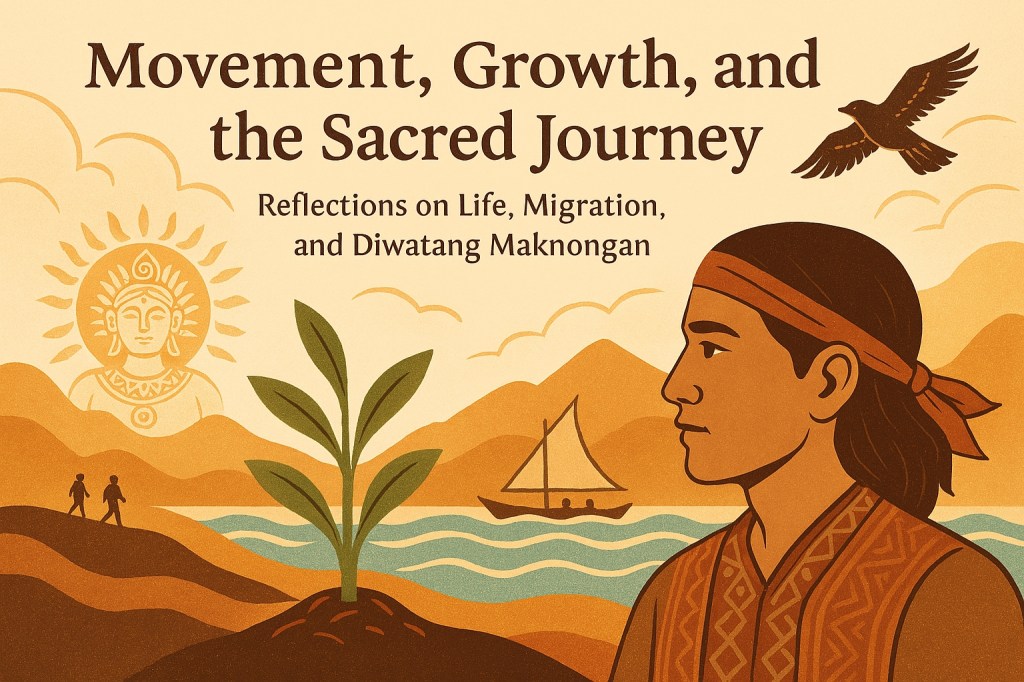
In both the natural and spiritual worlds, life is recognized by its capacity to grow and to move. Growth is not merely an increase in size, and movement is not simply a change of location. Together, they form a deeper pattern: life responding to reality, adapting to conditions, and unfolding toward wholeness.
This reflection emerged from a simple question: Is growth and movement a characteristic of life? The answer, when viewed through the lens of Indigenous spirituality and Binabaylan wisdom, opens a profound understanding of humanity’s journeys—past and present.
Growth and Movement as Expressions of Life
All living beings grow. Growth is a universal marker of life, manifested in physical development, learning, emotional deepening, and spiritual awakening. Movement, however, requires nuance. Not all movement is visible, and not all life moves from place to place. Plants move by growing toward light and water. Cells move internally. Souls move through experiences.
Thus, movement in its truest sense is responsiveness—the ability of life to adjust, seek balance, and continue becoming. From this perspective, growth and movement are inseparable. Growth requires movement, and movement invites growth.
Nomadism and the Ancestral Pattern of Humanity
Early humanity lived nomadically, not by accident, but by necessity and wisdom. Nomadism was a way of listening to land, seasons, animals, and weather. When a place could no longer sustain life, people moved—not in defiance of nature, but in relationship with it.
This ancient nomadism was not rootlessness. It was a living dialogue between human communities and the earth. Life survived because it moved.
In this sense, nomadism reveals an original human truth:
Life stagnates when it refuses to move; life endures when it responds.
The Filipino People as a Migratory People
The Filipino experience carries this ancestral pattern into the present.
Long before colonization, our ancestors were seafarers, traders, and settlers across islands and oceans. Migration is written into our bones and memory. In modern times, Filipino migration has taken new forms—overseas work, permanent resettlement, and diasporic communities scattered across the world.
Often, this movement is shaped by imbalance: economic injustice, colonial legacies, and unequal systems. Yet even within these painful realities, migration remains an expression of life seeking dignity, survival, and growth.
Filipino migration today can be understood as modern nomadism—an echo of an ancient inheritance, complicated by history but still animated by life force.
Diwatang Maknongan and the Structure of Living Reality
Within the cosmology of Templong Anituhan, Diwatang Maknongan is understood as the Tagahabi ng Estruktura—the one who structures reality so that life can unfold.
Maknongan does not impose stillness. Instead, Maknongan establishes:
•conditions for relationship,
•pathways for interaction,
•and patterns that allow life to respond and adapt.
Movement and growth are not deviations from divine design. They are expressions of it. The world structured by Diwatang Maknongan is not static. Realms interact, elements cross, spirits travel, and souls journey between embodiment and return. Life is meant to flow (daloy), not freeze.
When Movement Becomes Disharmony
However, not all movement is harmonious.
Movement becomes disharmony when it breaks relationship:
•when land is taken without consent,
•when people are displaced without dignity,
•when migration is forced by violence or exploitation,
•when movement becomes extraction without return.
This is not the structure of Maknongan, but humanity’s imbalance within that structure.
To move in harmony, we must:
•move with consent, not conquest;
•carry relationships with us, rather than sever them;
•give back wherever we go;
•pause, ritualize, and integrate transitions;
•and choose movement that affirms life rather than destroys it.
In Binabaylan ethics, ang dumadaloy ay dapat may balik—what flows must also return.
A Journey to Hawaiʻi: Teaching, Listening, and Kinship
As I prepare to travel to Hawaiʻi for a month to share the teachings of Hilot Binabaylan, this reflection becomes embodied. The journey is not simply geographic. It is a sacred crossing.
Hawaiʻi is not merely a destination; it is a kin land—an island culture shaped by ocean, ancestry, and living relationship with the earth. To enter such a place is not to arrive as an expert, but as a guest.
This journey is an extension of home, not an abandonment of it. Hilot Binabaylan is not being uprooted; it is being allowed to breathe in another shore, in dialogue with another Indigenous wisdom.
Blessing for the Journey
As I step into this movement, I carry a simple prayer:
Diwatang Maknongan,
Tagahabi ng landas at daloy ng buhay,
let this journey remain aligned.
May I move with respect,
teach with humility,
and listen as much as I speak.
May what is shared take root only where it is welcomed,
and may what is received return as wisdom.
In movement, may relationship be preserved.
In growth, may harmony remain.
Closing Reflection
Life grows because it moves.
Movement remains sacred when it remembers relationship.
Nomadism, migration, teaching journeys, and crossings of sea are not accidents of history. They are expressions of a living structure—one woven by Diwatang Maknongan—inviting humanity to respond, adapt, and become whole.
May all our journeys, chosen or imposed, find their way back to harmony.
 Templong Anituhan
Leave a comment