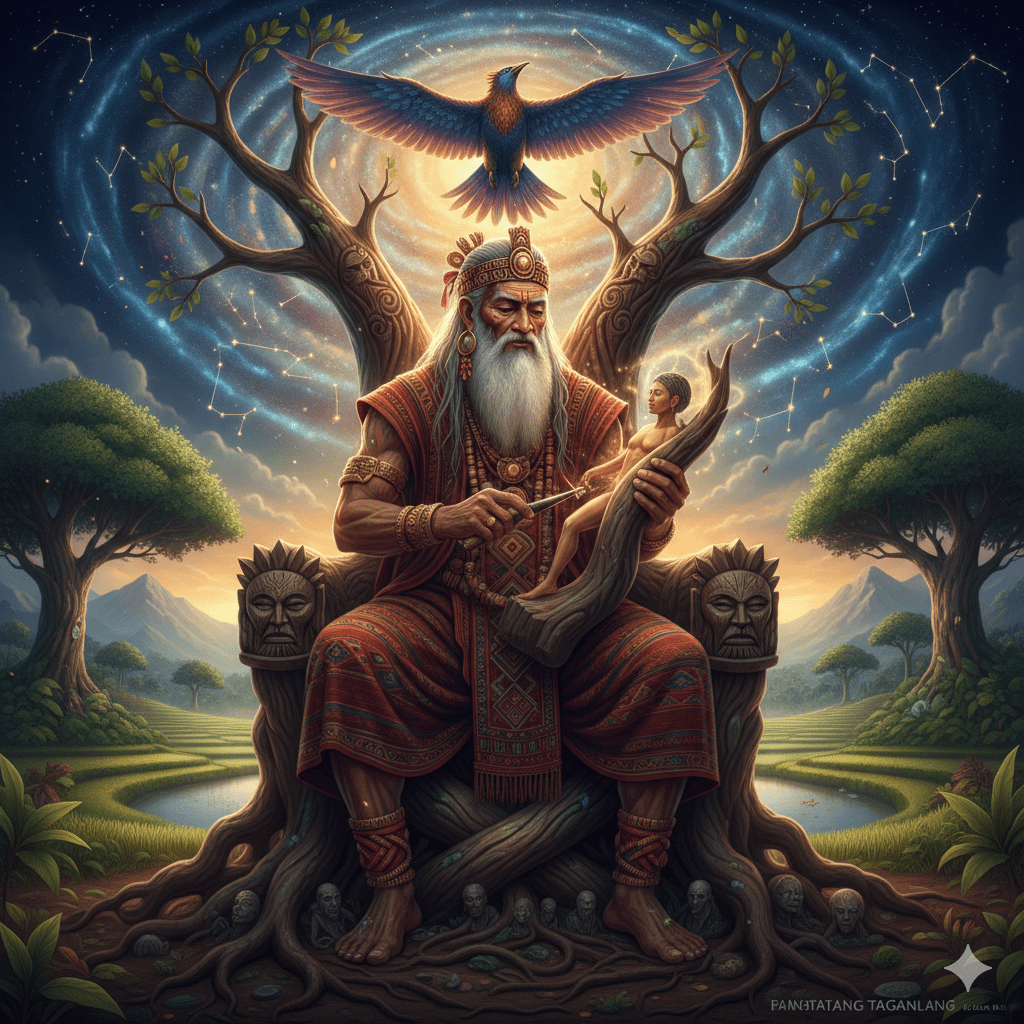
In the lush, mineral-rich mountains and valleys of Davao de Oro, Philippines, live the Mansaka people. Their culture is a vibrant tapestry of intricate weaving, ancestral chants, and a profound connection to the land. At the heart of their spiritual universe lies a fascinating and powerful figure: Diwatang Taganlang, the ancient Creator God.
While many indigenous groups in Mindanao speak of “Magbabaya” as the supreme deity, for the Mansaka, Taganlang holds a special, foundational place as the “Architect of Humanity” and the “Owner of the World.” Understanding Taganlang is key to grasping the very essence of Mansaka identity and their enduring code of conduct.
Taganlang: The Divine Sculptor and First Teacher
Imagine a god who doesn’t just speak the world into existence but meticulously crafts it. That is Taganlang. Mansaka oral traditions vividly describe him as the divine artisan who:
* Carved the First Humans: Using Kasili wood for the first man and Bangay wood for the first woman, Taganlang breathed life into his creations. This act imbues every Mansaka with the profound belief that the human body is sacred, a “borrowed vessel” from the Creator.
* Taught the First Words: After giving them life, Taganlang became the “First Teacher.” He personally named every plant, animal, mountain, and river for the first man and woman. This established the Mansaka’s deep reverence for knowledge, language, and the intricate web of nature.
* Owner of All Life: The name Taganlang itself is often interpreted as “The Owner” or “The Master.” He presides over the Upper World, with his celestial messenger, the bird Oribig, surveying his creation.
The Shift to Magbabaya: A Tale of Spiritual Evolution
So, if Taganlang is so central, why do many Mansaka today more frequently invoke Magbabaya? This shift reflects a common phenomenon in indigenous spiritualities:
* Linguistic Convergence: “Magbabaya” (meaning “The Planner” or “The One Who Wills”) is a widely used term for a supreme deity across various Lumad groups in Mindanao (Higaonon, Bukidnon, Talaandig, etc.). As tribes interacted, this term became a more generalized way to refer to the Creator.
* Contextual Usage: While Taganlang remains the specific, ancient name rooted in the Mansaka creation epic, Magbabaya often serves as the functional name used in daily prayers, healing rituals led by the Balyan (shamans), and discussions with outsiders.
* Shared Essence: For many Mansaka elders, Taganlang and Magbabaya are two names for the same ultimate divine force—Taganlang is the original name of the Creator, while Magbabaya is the active principle of divine will in the world.
Regardless of the name invoked, the underlying principles of respect, balance, and stewardship remain firmly rooted in the ancient teachings attributed to Taganlang.
The Timeless Code: Living by Taganlang’s Teachings
The Mansaka do not have a written scripture, but Taganlang’s influence is the foundation of their Kaugalian (customary law) and moral compass. This code is passed down through generations via epic chants (Dawot) and the wisdom of the Matikadong (council of elders).
Here are the fundamental teachings that guide a Mansaka’s life, derived from the spirit of Taganlang:
* The Sanctity of Life:
* Teaching: Since Taganlang crafted each human body, life is a sacred, borrowed gift. Violence, especially murder, is an affront to the Creator’s design.
* Practice: This underpins their deep value for peace (Kadaitan) and the elaborate rituals for reconciliation. Even warriors (Bagani) faced spiritual burdens for taking a life.
* Stewardship of the Land (The “Owner” Principle):
* Teaching: Humans do not own the Earth; Taganlang does. We are merely its caretakers.
* Practice: Every act, from clearing land for farming (saka) to harvesting a forest product, requires a ritual asking Taganlang and the nature spirits (Diwata) for permission. To exploit nature without respect is to steal from the Creator.
* The Power of Identity and Knowledge:
* Teaching: Taganlang gave the first humans names for everything, establishing knowledge as a divine gift. To know your history, your language, and the names of your surroundings is to stay connected to the Creator.
* Practice: The Mansaka fiercely protect their language and oral traditions, viewing the forgetting of one’s culture as a spiritual loss, a disconnect from Taganlang himself.
* Harmony and Balance (Kadaitan):
* Teaching: Taganlang created a balanced universe. Human actions should always strive to maintain this equilibrium, avoiding greed, excessive pride, or disrespect that could invite the wrath of malevolent spirits (Busaw).
* Practice: When natural disasters or illnesses strike, it is believed the balance has been disrupted, leading to communal rituals to restore harmony.
* Respect for Life-Givers:
* Teaching: The creation of woman from strong Bangay wood signifies the sacred role of women as life-givers and spiritual conduits.
* Practice: This is reflected in the traditional power of the Balyan (spiritual healers and mediums), who are primarily women, seen as having a closer link to the creative forces of Taganlang.
Living Taganlang’s Legacy Today
In a rapidly changing world, the Mansaka continue to navigate the currents of modernity while holding fast to the anchors of their heritage. The teachings of Diwatang Taganlang—whether invoked by his ancient name or through Magbabaya—offer a profound wisdom for all of us: to respect life, cherish our planet, honor our ancestors, and live in harmony with the seen and unseen forces of the world.
These aren’t just ancient beliefs; they are a timeless blueprint for a sustainable and meaningful existence.
 Templong Anituhan
Leave a comment