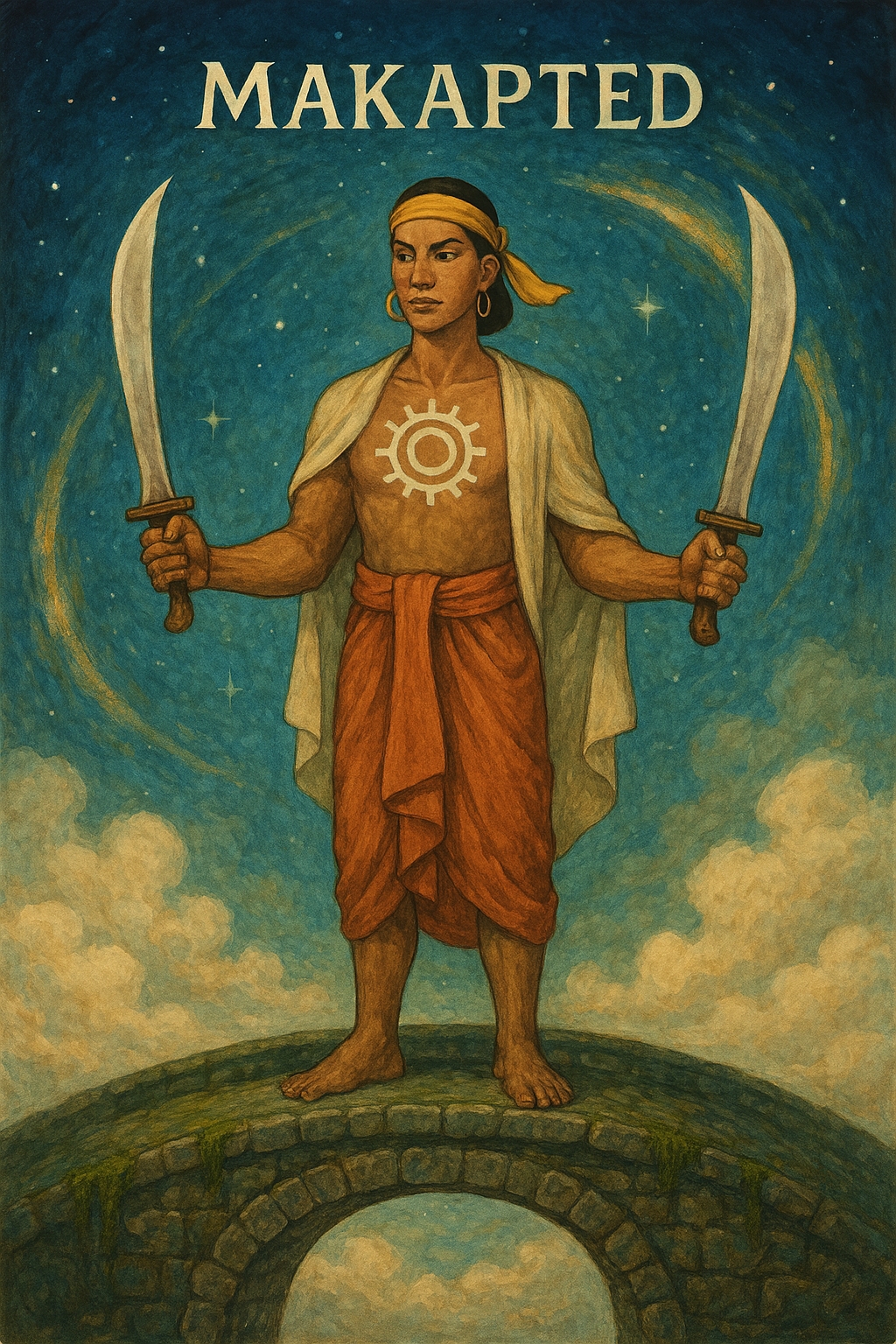
In the rich tapestry of Filipino cosmology, every Diwata holds a unique role that reflects the values and spiritual truths of our ancestors. Among these divine beings, Makapated stands as a profound symbol of connection and separation, embodying the delicate balance between individuality and unity.
Linguistic Roots
The name Makapated carries deep meaning:
– Maka-: A Tagalog prefix meaning aligned with, in favor of, or having the ability to. It conveys advocacy and empowerment.
– Pated: Likely derived from patid (to cut, sever, or break). Spiritually, this suggests boundaries, transitions, and the power to sever or reconnect.
When combined, Makapated can be interpreted as:
– The One Who Has the Power to Sever or Connect”
– In Favor of Brotherhood or Sisterhood
This dual meaning makes Makapated a Diwata who governs thresholds and kinship, advocating harmony while respecting necessary boundaries.
Cosmological Role
Makapated resides in the Kaibabawan (Middle World), serving as a Threshold Guardian between realms. While Bathala presides over the Upper World and Kailaliman holds the depths, Makapated ensures balance at the crossroads of existence.
Domains of Influence
– Boundaries & Crossings: Physical (doorways, rivers), spiritual (life-death transitions), and social (alliances, reconciliations).
– Kinship & Solidarity: Brotherhood, sisterhood, clan unity, and interfaith harmony.
– Severance & Renewal: Cutting toxic ties and forging new, life-affirming bonds.
Makapated in Creation Myths
In the Templong Anituhan cosmology, Makapated plays a pivotal role during the Primordial Separation:
– The First Boundary: When Bathala shaped the heavens and Kailaliman stirred the depths, chaos threatened to merge all realms into one indistinct void. Makapated intervened, severing the tangled threads of existence, creating space and order.
– The Bridge of Kinship: After dividing the realms, Makapated wove the first bridge of light and water, allowing spirits and mortals to cross when harmony was needed. This act established the principle that boundaries exist not to isolate, but to guide connection with respect.
– The Covenant of Brotherhood: Makapated taught early beings the sacred law of Pagkakapatiran (Brotherhood), declaring that while paths may diverge, all life remains bound by a shared origin. This covenant became the foundation for rituals of reconciliation and unity.
The Twin Blades of Makapated
Central to Makapated’s power are the Twin Blades, each embodying a cosmic principle:
1. Blade of Severance
– Purpose: To cut away chaos, harmful ties, and anything that threatens harmony.
– Mythic Role: Used to divide the realms during creation, bringing order to primordial chaos.
– Lesson: Growth often requires letting go. Boundaries protect life and preserve balance.
2. Blade of Union
– Purpose: To bind and reconnect, forging new ties of kinship and solidarity.
– Mythic Role: After separation, Makapated used this blade to weave bridges between worlds.
– Lesson: True unity respects difference. Connection is sacred when chosen freely and maintained with care.
Why Two Blades?
Makapated teaches that both cutting and binding are acts of love when done with wisdom. Boundaries and bridges are not opposites—they are partners in harmony.
The Bridge: A Sacred Symbol of Connection
The bridge is one of Makapated’s most powerful symbols, representing the pathway between separation and union. It embodies the idea that boundaries are not meant to isolate but to guide respectful connections.
Layers of Meaning
– Liminal Passage: The bridge marks the threshold between worlds—life and death, chaos and order, isolation and community. Crossing it is an act of transformation.
– Kinship and Brotherhood: It reflects Makapated’s advocacy for pagkakapatiran, reminding us that even when paths diverge, all beings share a common origin.
– Balance of Opposites: A bridge connects two separate points without erasing their individuality, teaching that true harmony honors difference while fostering connection.
– Spiritual Journey: Walking the bridge symbolizes **transition and growth**—moving from ignorance to wisdom, conflict to peace, brokenness to wholeness.
In Ritual Practice
– A rope or wooden bridge can be placed on the altar to signify crossing into harmony.
– Bridge-crossing ceremonies are used in rites of passage, reconciliation rituals, and interfaith gatherings.
Symbols and Elements
– Bridge or Rope: Represents connection and severance.
– Twin Blades: One for cutting, one for binding.
– Circle with a Break: Signifying both division and reunion.
– Elemental Alignment: Air (communication) and Water (emotional flow).
Invocation
Makapated, Tagapamagitan ng Hangganan, Tagapagtanggol ng Pagkakapatiran, kami’y iyong gabayan sa pagtawid at pagkakasundo.
(“Makapated, Mediator of Boundaries, Defender of Brotherhood, guide us in crossing and reconciliation.”)
Ritual Contexts
– Naming Ceremonies: Affirming identity and kinship.
– Conflict Resolution Rites: For families, communities, or interfaith gatherings.
– Transition Rituals: Birth, marriage, death, migration.
Makapated in Modern Spirituality
In today’s world of divisions and disconnections, Makapated reminds us that boundaries are not walls—they are bridges waiting to be crossed with respect and understanding. This Diwata calls us to heal broken ties, honor differences, and embrace unity without erasing individuality.
 Templong Anituhan
Leave a comment