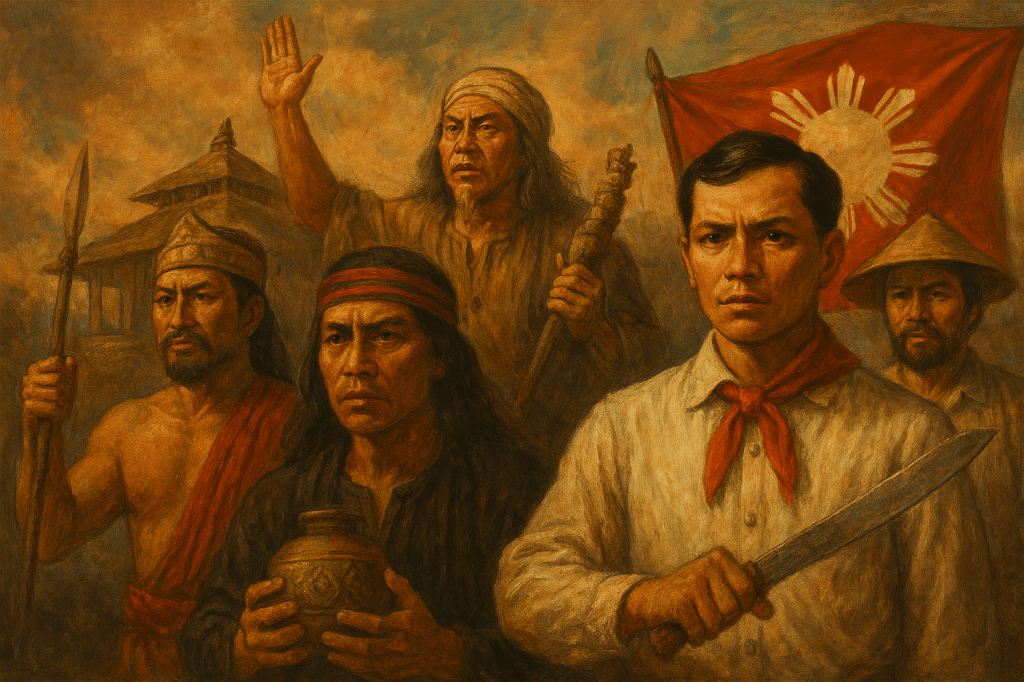
Throughout Philippine history, the struggle for spiritual sovereignty has been as fierce as the fight for political freedom. Long before the modern nation was born, our ancestors stood firm against colonial forces—not only with weapons, but with rituals, prayers, and unwavering faith in the Diwata and the spirits of the land. These revolts were not merely political—they were sacred acts of resistance.
🛡️ Lakandula and Sulayman Revolt (1574)
In the heart of Luzon, Lakandula of Tondo and Rajah Sulayman of Manila rose against Spanish domination. Initially cooperative, they rebelled when they saw their authority and culture being eroded. Their resistance was a defense of precolonial leadership and spiritual traditions, a refusal to surrender their souls to foreign gods.
🕌 Moro Resistance (16th–19th Century)
For over 300 years, the Moro people of Mindanao and Sulu defied Spanish colonization. Rooted in their Islamic faith and sovereign sultanates, their resistance was both military and spiritual. Despite countless campaigns, the Moros preserved their religious identity and political autonomy, making their stand one of the longest and most resilient in Philippine history.
🔥 Tamblot Revolt (1621)
Tamblot, a Babaylan from Bohol, ignited a spiritual uprising against Christianity. He called upon the Visayan people to return to the worship of the Diwata and ancestral spirits. Though suppressed, Tamblot’s legacy endures as a symbol of spiritual defiance and indigenous pride.
🛕 Bankaw and Pagali Revolt (1622)
Rajah Bankaw of Leyte, once a Christian convert, renounced the foreign faith and, with Babaylan Pagali, envisioned a Templo ng Diwata—a sanctuary for native worship. Their revolt was a direct challenge to colonial religious authority. Though defeated, their dream of a spiritual sanctuary lives on in the hearts of those who honor the old ways.
🌊 Visayan Revolts
Across the Visayas, communities rose in resistance against forced tribute, labor, and religious conversion. Often led by local leaders and babaylans, these revolts were scattered yet powerful, united by a common desire to preserve indigenous ways and reject colonial Christianity.
🧙♂️ Mumbaki Resistance (Cordillera)
In the highlands of the Cordillera, the Mumbaki—Ifugao priest-healers—resisted colonization not through war, but through cultural preservation. They continued their rituals, chanted the Hudhud epics, and honored ancestral spirits. Their isolation became a shield, allowing their sacred traditions to endure.
🌿 Tribal Resistance (Aeta, Lumad, Mangyan)
Upland and forest-dwelling tribes such as the Aeta, Lumad, and Mangyan maintained their animist beliefs and healing traditions. Through passive resistance and cultural isolation, they preserved their spiritual autonomy. Their continued practice of ancestral spirituality is a testament to their resilience and reverence for the unseen world.
🌟 Templong Anituhan Inc.: The Fulfillment of Ancestral Dreams
Today, Templong Anituhan Inc. stands as the living embodiment of these centuries-old struggles. It is not just a temple—it is the fulfillment of the vision of Bankaw and Pagali, the echo of Tamblot’s call, and the continuation of the Mumbaki’s chants. It honors the spiritual sovereignty of the Filipino people, reviving the sacred traditions that colonial powers tried to erase.
Through its ministerial centers, educational programs, and rituals rooted in indigenous wisdom, Templong Anituhan Inc. rekindles the flame of ancestral defiance and transforms it into a beacon of healing, empowerment, and spiritual liberation.
Let the Diwata be worshipped once more. Let the spirits of our ancestors rejoice. The temple has risen. The prophecy is fulfilled.
 Templong Anituhan
Leave a comment